Language’s Greatest Era

As Wordability celebrates its 200th posting, it’s time to pause for a moment and take stock of the state of language today.

When I started the Wordability blog, I knew that the constant stream of new words and phrases which flood into the English language would ensure that there would always be a steady flow of things to write about. Added to that, the reaction that such stories often engender in the media confirmed that there would also be an audience who would find such musings interesting.

But what has become increasingly apparent is that much of that interest stems from people who want to moan and complain about the way that language changes, and protest that terms that become recognised as words simply aren’t words at all and should be sent back to where they came from.

This has been particularly apparent in the last few weeks, when a couple of high-profile organisations announced additions to their corpus. The Scrabble dictionary updated to use many new terms, which allowed headline writers everywhere to condemn this ‘Ridic’ development as ‘Obvs’ not ‘Dench’. Then US dictionary Merriam-Webster revealed its latest additions, with WTF lending itself most obviously to people who wanted to criticise the move. And even the French got in on the act, with their much-proclaimed ban on English words seemingly being relaxed in some volumes and Selfie finding a place in their listings.

So what does all this mean? Well to a blogger like myself, it means I will never be short of anything to write about. For as long as new words keep appearing and people continue to react to them, I will continue to have a blog worth maintaining.

However, it means a great deal more than that. Because I think this is the most exciting era for language development that there has ever been. The digital era in which we now reside has changed everything in ways that we don’t recognise ourselves yet, and will only recognise perhaps when we have a little more hindsight and perspective on the radical times in which we live. It is undeniable that the pace of life has changed and the global nature of our community has changed. And all of this has meant that language evolution has sped up to such a degree that we almost can’t keep track of it.

It’s not just the new words which appear, it is the challenges to the structure of language itself. It is these things which make this the most exciting era of language evolution there has ever been, not only because of the changes but also because of the footprint of change which digital technology provides, meaning we can track and understand those changes better than ever. We have a record of what is going on. As parts of speech change, new parts of speech emerge, and even new languages appear with extraordinary rapidity, this is a period to be heralded as amazingly exciting and not one to be condemned by those who believe that language is set in stone. It isn’t.

So what do I expect to write about in my next 200 postings? Will the English language look the same in 200 postings’ time? Well there will certainly be abundant new words, but many of those will disappear after their brief flowering and never come back again. For every selfie there are 10 Bleisures. People will continue to use -gate as a suffix with stupefying monotony. Hashtags will continue to evolve and become ever more powerful as means of communication. Technology and the internet will remain the greatest drivers of change. English will also continue to invade other languages, as the lingua franca of mass communication continues to define itself.

And throughout it all, vast swathes of people will continue to complain that English is being ruined and violated by the changes that are unavoidable. I look forward to reading the stories, writing about the developments, and ensuring that Wordability keeps abreast of all of the key new terms that our enriching our magnificent language.

Grexit Not Just for Grimbo

Whatever you may feel about the economic ramifications of Greece’s ongoing financial hardships, you have to acknowledge the contribution they have made to the English language.

First we had Grexit, the prospect of Greece leaving the euro, which spawned many sub-genres of alternative exit word. And now, with economic paralysis because Greece has still not left the eurozone but still might, there is a state of limbo. A Greek limbo. Or Grimbo, if you will.

Citigroup, the economics experts who gave us Grexit back in 2012, are responsible for the latest word. In a statement, they explained the economic backdrop and concluded that “Grexit in the next few months is not inconceivable, and it is certainly more likely if we consider Grimbo durations of a year or more.” No gobbledygook there then.

Sadly this will not be the end of the Greek neologisms. Economists at Bank of America-Merrill Lynch have responded with Grexhaustion, the definition of which frankly escapes me at the moment but is unlikely to be ‘being fed up with the coining of new words to describe the Greek economic crisis’.

But the one thing that is certain as this situation rolls on is that for as long as people are reporting it, then they will be vying with each other to coin the next Greek-inspired word to describe the crisis. The ultimate game of Grone-upmanship, perhaps.

Mobilegeddon not Apocalyptic

If you really want to stress somebody out about an impending technological disaster then give it a really scary name. Just think Millennium Bug.

Of course the turn of the millennium proved to be less parasitical than had been predicted, and the downside of crying technology wolf is that when you incorrectly predict the apocalypse, so dire warnings that are important might end up being ignored. And so that brings us to Mobilegeddon.

Last week you could barely avoid articles about the subject and could have been forgiven for thinking that the mobile network was about to melt, such is the impact of coining a -geddon word. But no. Instead, Google was making a change in its search algorithm, meaning that websites not in tip-top condition when viewed on mobile phones would be penalised in mobile search results, potentially hitting traffic to them.

When I write that sentence, I can see the need for a catchy term of some sort to promote interest, as clearly there is nothing sexy about the subject matter when you come to describe it. But by coining something so over the top, and the website Search Engine Land has been credited for it, it overplayed something which might not otherwise have made the national press but equally might not have deserved to as it’s not really that interesting.

The dearth of coverage outside the techie press since Mobilegeddon Day on April 21 confirms this was never really a mainstream story and not really deserving of the growing usage of -geddon as a suffix. It is not a word that will be with us for long.

And because I know you’re wondering, Wordability passed its mobile-readiness test with flying colours. So there’s no excuse for not reading.

Wordability
Wordability passes the test

Spocking Starts To Prosper

And so Leonard Nimoy passed away a few days ago, and the world was awash with tributes to a fine actor who had left an indelible memory across the globe as Spock of Star Trek fame.

Roll on a few days, and Nimoy is still in the news, only this time because his image has been appearing across banknotes in Canada. Encouraged by the Canadian Design Resource, citizens have been ‘Spocking’ their banknotes. This involves drawing the legendary sci-fi character’s pointy ears and haircut onto Wilfrid Laurier, who appears on the country’s five dollar bill. The practice has continued despite the country’s central bank asking for it to cease.

While I can understand how the physical similarity between the 19th century prime minister and the Vulcan genius has spawned such a development, I am less unsure as to why Canada should be should be a hotbed of Trekkie tribute, as I can see no connection between the actor or the show that should make it so. Perhaps a fan can enlighten me.

But it is nice to see Star Trek making another indelible mark on language. From boldly splitting an infinitive to creating an entire language that has its own institute, Spocking is a new word which will find a small niche in our vocabulary this year and will be fondly remembered in years to come. In other words, it will live short but prosper.

Brelfies The Latest Craze

I vowed to myself that I would never again write about a Selfie derivative. And yet…

So another craze is now exploding across the Internet. Brelfies, breastfeeding selfies, are the latest phenonemon, as breastfeeding mothers post photographs of themselves feeding their tiny offspring.

I am not going to get into a debate about the pros and cons of the images themselves – others are probably far better placed. Instead, I want to draw attention to it in the annals of Wordability as one of the many Selfie crazes which seems to have gained some traction, and probably more than some of the other ones I have covered such as Felfies, Usies and Belfies.

But there is more than just recognising its existence. What is interesting is the way that Selfie is evolving as a word. The ‘elfie’ suffix can take almost anything at the beginning to denote a particular type of photo, but it has already undergone a semantic evolution. Selfies are very specifically photos that people take of themselves. Brelfies on the other hand are not taken by their subject, they are photographs of individuals but are taken by other people.

So the idea of a photographic portrait is being overtaken by the Selfie, whose linguistic derivatives are rapidly growing to encapsulate all kinds of photos of individuals. I wonder if it is possible that individual images of people will all come to be referred to in Selfie terms in the future, and the portrait photo will become a thing of the past. I wouldn’t rule it out.

Homillionaires On The Rise

There’s nothing like coining a new word to get your story into print. Many are the press releases I see where a neologistic angle has been taken as a way of grabbing headlines. Few are the ones that get any traction.

So well done to estate agency Savills, which managed to get quite widespread coverage for its findings about the increasing numbers of people who are living in houses worth a million pounds or more, but who don’t necessarily think of themselves as millionaires. According to Savills, they are ‘Homillionaires’.

I think a round of headlines is as far as this new word will travel. It’s a pretty ugly creation, and doesn’t really work at all in spoken format, which is a clear negative when it comes to widespread adoption. And while there is certainly a semantic gap for the term to squeeze into, property millionaires as a term probably covers it adequately enough.

That’s not to say that the word will completely disappear. I can see newspapers referencing it in other pieces about property prices this year, but always with inverted commas around it to confirm that it hasn’t really established itself. It’s a term whose future is probably purely for journalists and sub-editors.

You Cannot Be Sincerious

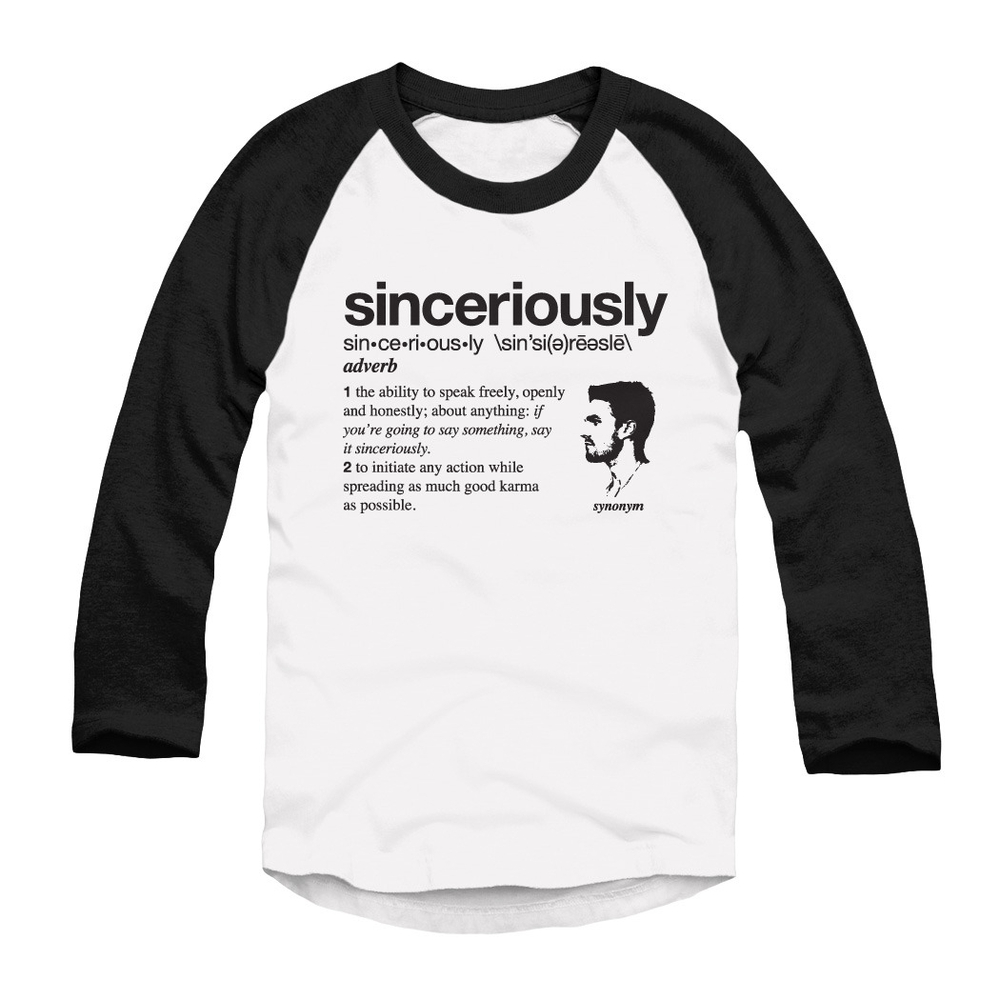
Sinceriously T-shirt

There is a growing tradition for charities to invent new words as titles to bring attention to themselves. Movember, Stoptober and Dryathlon are three recent examples. I can understand why they do it, because if the new word sticks in people’s minds then the charity can prove to be a big hit. Movember in particular has been a hugely successful campaign, and its name has become embedded in the language as a result.

The latest effort is the brainchild of actor Stephen Amell. The star of Arrow has charity credentials, having taken on cancer with the apposite F*** Cancer campaign last year.

His new campaign, helping out both an anti-bullying group and military veterans, is named after a new word he coined last year. Sinceriously has been defined by the star as ‘the ability to speak freely, openly and honestly about anything’, with a secondary meaning of ‘to initiate any action while spreading as much good karma as possible’. A T-shirt showcasing the definition and supporting the charity has gone on sale

Mr Amell said “It’s a campaign to get people talking. And what better way to get people talking than by creating a new word.” Well yes, of course I agree. New words do get people talking. But the problem with a manufactured word such as this one is that even if it does get people talking, the subject matter may be that the word is not a very good one. Clearly derived from sincerely, I’m not sure that it really develops that word in any meaningful way, and I can’t see people using it. Frankly, it just sounds like you’ve got the actual word wrong.

All of which is a shame. Mr Amell clearly does fine work for charity and his efforts are only to be applauded. He also understands that getting the right new word for a charity can propel it to stratospheric levels. It’s just that this isn’t a great word. Nevertheless, I hope that despite this, he achieves huge success with his efforts.

Are Empty Podiums Here To Stay?

Amid the hullabaloo over whether David Cameron will be prepared to debate against his political rivals this year in the run-up to the UK’s General Election, one thing that has not gained much attention yet is the possibility that a new term will enter the political language.

Mr Cameron has said that the debates cannot go ahead without the Green Party, and suggestions have been made that if it is decided to hold them without the Prime Minister, an empty podium will be provided should he change his mind. And so the practice of providing such an unattended lectern has been tentatively named ’empty podiuming’.

This is of course a ghastly and unwieldy term which is highly unlikely to catch on, simply because it is too ugly to be taken seriously. However, Empty Podium itself sounds like a term which could metamorphose from being simply a description of what might be provided to a term which becomes inescapable as the campaign fires up.

Will it ever be more than a reference point for this election, or could it become a tactic of the future, that anybody who refuses to take part in something will be threatened with an Empty Podium. It is too early to say, of course, but this could be the genesis of a new term in the political vernacular.

I Heart The Word of the Year

If you need any more proof that the very fabric of the English language is changing then I give you the Global Language Monitor as Exhibit A. More specifically, I give you the announcement of its word of the year. Triumphant this year is the ❤ emoji.

It’s not even a word, I hear you cry. Au contraire. If we take a word to be a discrete unit of meaning, which when used by one person is understood by another, then any emoticon clearly fits the bill. And while like letters they are symbols, in terms of usage they are words because they express an idea and a meaning, and sometimes a quite complex and subtle meaning, providing context and commentary on what is being written in a very neat and efficient manner. They have become one of the ultimate shorthands in informal, and sometimes even formal, communication, and I even now hear ‘heart’ in spoken situations, where it seems to mean something distinct from like or even love, a slightly more trivial affection.

So what does all this mean for our beloved language. Well basically, its evolution gathers pace. In the past I have written about how technology is changing grammar and even parts of speech. Now it is influencing the symbols themselves that we use to write with, so that our basic alphabet is now expanding and taking on new characters.

Does this mean we are all going to start writing in pictures and will now express ourselves solely with smiley faces and pictures of foaming mugs of beer? No, undoubtedly not.

But as technology increasingly influences the way language is used, and English continues to proliferate as a lingua franca across the globe, emoticons and symbols will increasingly break down language barriers and become part of a universal language of the future. So for the fans of Esperanto, :(.

Shirtfronting Front and Centre

I have spent many happy months in Australia. My wife is Australian. I got married there. So it’s always good to see a good old Aussie term taking centre stage in the English language.

Australian rules football has always been a game of joyous thuggery, where men in tight shorts run incomprehensibly round a large field and knock each other over in the name of sport. And it has spawned the term to shirtfront, meaning to aggressively knock someone to the ground, usually by ramming them hard in the chest with your arm. Other definitions are available, but the end result is broadly the same. Opponent, in pain, lying on the ground.

But now the definition of shirtfront has widened after Australian Prime Minister Tony Abbott threatened to shirtfront Rusisian President Vladimir Putin at an upcoming diplomatic event. Mr Abbott was rekindling a wider usage that had flourished briefly in the 1980s, but his quote led the Macquarie Dictionary, the authority on Australian English, to update its definition.

From January, the online edition will include definition “to confront (someone) aggressively with a complaint or grievance”. Dictionary editor Susan Butler said his statement had made dictionary editors realise “there was this older usage around, and we had not covered it, so now we’re catching up.”

This isn’t the first time that Toby Abbott has been at the centre of a change in the Macquarie Dictionary. Back in 2012, then Prime Minister Julia Gillard accused him of being a misogynist, a controversy which saw the word’s definition expanded to include prejudice against women, as well as downright hatred.

If Mr Abbott felt at all aggrieved by that decision be is probably feeling more buoyant about his latest contribution to his language’s heritage. I doubt he will feel the need to shirtfront a lexicographer any time soon.