Grubering Set To Die Hard

Words can be incredibly powerful in the world of politics, so the US Republican party must be rubbing its hands together with glee at its linguistic triumph of the last few days.

Videos have emerged of economist Jonathan Gruber talking about President Obama’s flagship healthcare plan, known as Obamacare. Mr Gruber was one of the chief architects behind it, but in the videos, he is quoted as saying: “Lack of transparency is a huge political advantage. And basically, call it the stupidity of the American voter or whatever, but basically that was really, really critical for the thing to pass.” Subsequent videos of him citing the inability of Americans to understand the issues have emerged to really ram the point home.

And so Grubering has been born. Defined as lying to sell a political policy, the word is exploding across social media and the internet, with the Republicans seizing on it with delight. Swiftly derivatives are appearing, such as gruberish and gruberism. In fact, a whole family of words summing up the concept of lying and deceit as a political weapon to get a political bill to pass has now emerged, and shows no sign of stopping.

Words can be very powerful political tools to encapsulate a debate, they become a simple tool of reference. If a word such as this can stick in people’s minds, it will instantly serve a purpose which a lengthy speech might struggle to encapsulate. Democrats will probably be grateful it has emerged now, rather than in an election cycle, when a word can have the power to influence the result. Nevertheless, they will be hoping the word will have run its course by the time the presidential race begins in 2016. But my hunch is that this is a word that might prove to have more durability than that.
Vape Wafts To Oxford Accolade

I’d been wondering more than usual this year as to what Oxford Dictionaries would announce as its word of the year. The reason is that I don’t think it has been a vintage year for words. I’ve been struggling to think of a new word coined this year that has really taken off, and this has been my least productive year since opening the virtual files of Wordability.

So it’s not a surprise that Oxford’s choice this year is not a word coined in 2014, and it’s not a surprise that the word was nigh on impossible to predict. The Oxford experts have plumped for Vape.

Vape is both a noun and a verb associated with electronic cigarettes. As a verb it means to inhale and exhale the vapour produced by an electronic cigarette, while the noun refers to either the electronic device itself or the act of inhaling or exhaling the vapour produced.

Explaining the choice, Judy Pearsall, Editorial Director for Oxford Dictionaries, said: “As vaping has gone mainstream, with celebrities from Lindsay Lohan to Barry Manilow giving it a go, and with growing public debate on the public dangers and the need for regulation, so the language usage of the word ‘vape’ and related terms in 2014 has shown a marked increase.” That marked increase has seen usage of the word more than double over the last 12 months.

Other contenders were Bae, a term of endearment for one’s partner; Budtender, someone who dispenses cannabis; Contactless, relating to payments taken from cards or phones; Indyref, the Scottish Referendum; Normcore, ordinary clothes worn as a fashion statement; and Slacktivism, online participation for a cause but requiring little effort.

The real question for me is whether Vape really sums up 2014? Recent choices like Selfie and Omnishambles really summed up the mood of the year, they were great choices because they acted as a commentary on the 12 months they represented.

I can’t feel the same about Vape. When I think about 2014, Vape will not come to mind as a word that really captures the mood and spirit of the age. Rather it serves as a reminder of one particular development. Nonetheless, it could be the best of a bad bunch, as not only have great new words not emerged, actually capturing a sense of what the year has been all about has been strangely elusive in 2014.

And maybe that makes Vape a better and more profound choice than I first realised. It’s kind of unreal, ethereal even, and fake. Maybe a year that has been hard to sum up deserves a word of the year that relates to something which is a replacement for the real thing.

Photobomb Starts Word of the Year Season

So Word of the Year season has started, and Collins dictionary is first off the mark with Photobomb as its choice for 2014. Explaining its choice, it says that photobombing has come of age this year, with the habit of popping up unexpectedly in the back of people’s photos exemplified by Benedict Cumberbatch and The Queen among others this year.

Collins lexicographer Ian Brookes said that the word was an undeniable winner and had been tracked for a couple of years, adding: “Its vastly increased prominence in 2014 shows the power of media and sporting events to publicise a word and bring it into wider use.”

Second place went to Tinder, a dating app, while Bakeoff, as in the hit BBC cooking show, came third.

This depressing list highlights the conclusion I have rapidly been coming to over the last few months. After some excellent years for language fans, I think that 2014 has been sadly lacking in terms of great new words being coined, or even old words getting a new lease of leaf. Part of me can’t help feeling that photobomb has been given this accolade because of Selfie’s success last year. So often has it subsequently been quoted as the word of 2013, getting in early with another popular form of imagery spread by social media could be construed as trying to ride on its coat tails.

The fact that second place goes to an app and third place to a TV show simply reinforces to me that choosing words of the year for 2014 will continue to prove particularly difficult, and that we may not look back on 2014 as a vintage year for new words.

You Know When You’ve Been Pardewed

Sport has always been fertile ground for new words. and we sports fans are known to appropriate the names of our heroes or villains as words to describe particular achievements or ways of playing. Dictionaries have even been known to follow suit, with Lionel Messi recently finding himself lionised by lexicographers as his name came to encapsulate a level of sporting perfection.

During his recent troubles in north-east England, it is unlikely that beleaguered Newcastle manager Alan Pardew has been thinking much about his contribution to the English language. However, his surname has taken on a raft of new connotations in recent months, and he is unlikely to be best pleased.

Over the last few months, Geordies have been discussing the concept of being Pardewed. To Be Pardewed means to have previously been a great player and then to have lost all your talent and ability while playing under Mr Pardew’s tutelage, or to be a player of great potential who has simply not fulfilled it. To ‘celebrate’ their manager’s achievements, local journalists are even now writing articles about the best players to have been Pardewed over the years.

Pardewed is currently a local word, used almost exclusively in the part of the world where Newcastle dominate. But when you think about it, it is quite a useful neologism. We all have experience of bad managers in all walks of life, people who have shown incredible ability to get the worst out of people, destroy their confidence and end up creating a shell of the person that employee could have been.

Alan Pardew’s legacy at Newcastle looks increasingly likely to be a negative one. From a linguistic point of view, wouldn’t it be great at least if he could leave a mark on the English language as one of his parting gifts.

What’s been Fappening

It’s hardly surprising that the recent scandal over the hacking of embarrassing photos of celebrities has garnered so much attention. Pictures of stars such as Jennifer Lawrence and Kate Upton, wearing only what nature endowed them with, have gone viral across the globe, as have the investigations and accusations over how this could have happened.

One sideline to all of this from the Wordability perspective is that it has added a little nugget to the English language. I will freely admit to never having heard the term Fap before, but fortunately the Urban Dictionary is on hand to tell me that it is a slang term for masturbation.

Fap has ended up being used to to help create the term to describe this whole affair . The Fappening, a blend of Fap and Happening, has been coined as the catch-all title for this story, and it is now being used across the internet, in headlines and stories, as the key term by which to refer to the scandal. It has stuck because it makes it feel like a carefully stage-managed event, which of course it was. However, I’m sure it is a word that those directly affected by events will not take kindly to, which is perfectly understandable, potentially adding further distress to how they must feel about what has happened.

Fappening is not a word destined for dictionaries or longevity, but will certainly be used when we are summing up 2014 and looking back on the events which shaped the year.

And I am extremely grateful that linguistically, it didn’t follow usual protocol applied to scandals. Fapgate would have sounded so wrong.

Selfies Evolve Into Usies

Selfies have become inescapable over the last few months, and with their ubiquity has come variations concerning among others farmers and bottoms.

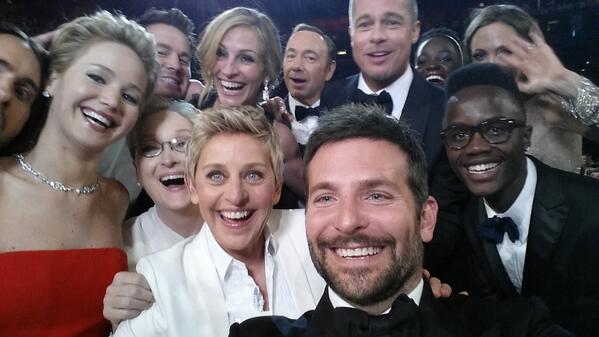
Now, the recent trend for selfies involving groups of people has spawned its own word. Usies (pronounced uss-ees) has been coined for the images which have been becoming increasingly prevalent since the famous Ellen DeGeneres shot of Hollywood royalty at the Oscars earlier this year.

Ellen DeGeners' famous Oscar photo
Ellen DeGeneres’ famous Oscar photo

The word was first used last year but is only now coming into consciousness and wasn’t really known when the Oscars took place. However the growing number of shared selfies now means that the need for the word is greater, hence its eventual emergence into more regular usage.

“Usies are a growing trend that I think have far more social value than selfies,” said Michal Ann Strahilevitz, a professor of marketing at Golden Gate University in San Francisco.

I actually think Professor Strahilevitz has a point. When I was writing about selfie being named word of the year last year, I was slightly despondent as I felt it described a slightly fractured and narcisstic society, obsessed with self at the cost of community.

While self-promotion is still at the heart of the usie, it is more about the people you are pictured with, the group rather than the individual. Is society moving towards greater unity and community again, rather than an obsession with self? The emergence of a new word is clearly flimsy evidence on which to base such an assertion, but if society does feel more cohesive and joined up in a couple of years’ time, it might be interesting to look back and see whether this linguistic trend really did mark a turning point.

A Word With Weird Al Jankovic

I feel a bit said that Weird Al Jankovic is probably not a fan of Wordability. The noted creator of parody songs has just released his new album, Mandatory Fun, which contains the song Word Crimes, a musical diatribe against the breaking of the rules of grammer and what is generally regarded as correct English.

I am in two minds about this song. On the one hand, I am a stickler for correct English, and have been noted for my pedantry over correct English over the years, especially when working in professional media organisations with my sub editing hat on. So I agree with the song’s sentiments when it comes to the written language in formal and published contexts.

On the other hand, Wordability‘s brief has always been to applaud the new words which come into English and make a difference, while to also acknowledge that as a living, breathing entity, English is changing, and the rules which people have worshipped for many years may ultimately be ripped up by the language’s users. Changes which are increasingly prevalent in spoken and digital language will almost inevitably be accepted into the grammatical and lexical rules of the future. Weird Al’s support for apostrophes and the alleged misuse of literally suggest he would have have disagreed with my postings on the subject.

But a small part of me wonders whether Weird Al really is as prescriptive as his song makes out. Word Crimes is a pastiche of Blurred Lines, the 2013 hit by Robin Thicke described by some as the most controversial song of the decade. The song describes apparent ambiguity in the way that men read women’s signals, but the lyrics have been interpreted by many as date rape, while the accompanying video has been accused of sexism, and the song has been banned in many places.

If Weird Al had truly wanted to stand up for grammar’s rules, might he have picked a less ambiguous and controversial song to use as the backbone for his apparent tirade? Or does his choice of song suggest that while he wants to get his grammar beefs off his chest, an element of him is trying to suggest that the situation is not as straightforward as might first appear?

I may be completely wrong. All of the commentary on this song suggests that it is a straightforward diatribe against bad English, and celebrity support from luminaries such as Kelsey Grammer, whose Twitter feed is dedicated to grammatical issues, would suggest I have a minority interpretation.

But we are dealing with a performer whose stock in trade is pastiche, and who has chosen a vehicle for his diatribe whose own meaning has been debated to death over the last 12 months. Perhaps Weird Al is not quite as obsessed about his rules of grammar as appears to be the case.

A New World For Columbus

We all know that Christopher Columbus discovered America. Actually, we know he discovered it on behalf of the western world, because the country was already inhabited when he arrived.

This nuance over the meaning of ‘discovered’ has seen a new word created in the last few days. A sketch on the College Humor website pokes fun at the idea of white people stumbling across things known to others for many years and then claiming ownership and therefore discovery of them. In honour of the fabled Christopher, this practice is known as ‘Columbusing’.

Columnists have already had lots of fun with this idea, with Miley Cyrus and Twerking featuring prominently in the commentaries of many as she is associated in the minds of lots of people as having discovered twerking, when it had in fact been around for some time.

I think it’s an interesting word as it is a really neat way of encapsulating a quite complex concept, which has both political and social overtones. Whether it has any life beyond this week’s flurry of media activity remains to be seen, but I can see it hanging around as a satirical term online, even if it never makes it into mainstream conversations and dictionaries.

Interestingly, a similar meaning of Columbusing appears to have been submitted to the Urban Dictionary over a year ago. So have the writers at College Humor Columbused Columbusing?

Spornosexual the New Metrosexual

We all know about the phrase that difficult second album. However, we don’t tend to hear about that difficult second neologism. The appearance of a sequel to a highly successful neologism this week has certainly made me think about the concept.

Back in 1994, journalist  Mark Simpson coined the term Metrosexual, There is no doubting its success as a new word. Metrosexual has certainly established itself as a word to describe a particular type of man with a meticulous approach to his own appearance, and it even carried off the American Dialect Society Word of the Year accolade in 2003.

So 20 years on, Mr Simpson has returned with an attempt to update his term and give us a new word for a new type of man. Writing in the Daily Telegraph, he gives us Spornosexual.

A spornosexual is a step on from a metrosexual. A fan of sport and pornography, he is a body and selfie-obsessed individual, and rather than just using clothes as a way of defining himself, he uses his body itself, by either tattooing it or honing it to perfection in the gym. And if that is not enough, he will even photoshop his own selfies to get that body image just so.

Given Mr Simpon’s history, and taking on board the veracity of his observations, it is not a suprise that the media have taken to his theory and his new word extremely quickly, with an outpouring of articles and analysis of this new trend he identifies.

But has he coined a second word which will have the same success as the first? I think probably not. Because I don’t think it is as neat a nelogism as his first effort. Spornosexual is actually a combination of three previous words, sports, porn and metrosexual. It’s a little like he has created the neologism sporn and then tacked it onto another word to get yet another word. This multiple method for creating the word makes it difficult to understand immediately, you really need someone to explain it to you to make sense of it, and that is where I think it falls down.

Metrosexual was so successful not only because it defined a clear new trend but the word itself was easy to understand and clearly represented its meaning. To be successful, a new word has to fill a semantic gap and be easy to understand and use. I think Spornosexual fails the latter of these criteria. It is a hard term to understand when you first hear it, and it is not at all obvious what it means. So for this reason, while Mr Simpson may have been spot on with his observations, his new word seems to prove the old adage that a sequel is never as good as the original.

A Phrase That’s Just Too Death Eaterish

JK Rowling may have achieved many things during her illustrious career, but trying to add a new term to common English usage is probably not one of them.

It’s certainly true that she coined many terms as part of the Harry Potter universe, and in one way she has created neologisms which have stuck. But words such as Quidditch, Muggles and Mudblood, which are now familiar to many and whose meanings are widely understood, are still Harry Potter words, and have not crossed over into everyday usage and other contexts.

All of which explains why her linguistic addition to the debate about Scottish independence this week received such a muted and almost hostile response. Rowling donated £1m to the No campaign, and in a lengthy defence of her position, especially criticisms of her connection to Scotland, she wrote: “When people try to make this debate about the purity of your lineage, things start getting a little Death Eaterish for my taste.”

There was inevitable debate about the meaning of the term Death Eaterish,  while with my Wordability hat on, I start to wonder whether it is something which could make the leap to the dictionary. But I think the fact that there were articles about what Death Eaterish actually means confirms that it is not a term which has any chance of being taken on more widely. For what it’s worth, Death Eaters rail against those who are not of pure blood, so you can see why Rowling used it when she was defending her right to a view on Scotland. She was not born there but lives there now. But Death Eaters cast a pall of despair wherever they go, while they are led by the most evil person in the Wizarding kingdom, so it does seem a little harsh to describe those who disagree with her in the same way.

Certain names from literature, such as Svengali, Don Juan and Utopia, have entered the language as regular terms. Death Eaterish, with its slightly esoteric meaning, and its ‘-ish’ formation, which makes it a little flimsy and wishy-washy in any case, does not seem to be one of those terms likely to have an equally successful linguistic future.