Because Language Changes

Even though it is now 2014, the final embers of 2013 are still upon us. Primary among this is the decision of the American Dialect Society to name Because as its word of the year.

Ben Zimmer, chair of the New Words Committee of the American Dialect Society, said that a change in its grammatical usage in informal online settings was behind the victory. He said: “No longer does because have to be followed by of or a full clause. Now one often sees tersely worded rationales like ‘because science’ or ‘because reasons.’”

That’s why I think this is such a fascinating victory. Much of the language change which is ascribed to new forms of digital communication revolves around neologisms, new words being coined and taking off quickly, abbreviations exploding as words in their own right. But the idea that online messaging can actually change the grammatical properties of a previously existing word is a fascinating one, and that such a well entrenched word as Because can gain a whole new lease of life because of a switch in usage really emphasises that the English language is in a state of flux and that its evolution is gathering pace.

I was also interested to see Slash taking second place. Used as a coordinating conjunction to mean “and/or” (e.g., “come and visit slash stay”), it is an example almost of a new type of word or grammatical formulation. I read a fascinating piece last year by Professor Anne Curzan from the University of Michigan about how slash is evolving as a new kind of conjunction, exactly the usage in fact which the American Dialect Society has cited.

So while Wordability‘s focus will remain on new words as they evolve, this blog itself may find itself evolving to look at new parts of speech and how the fundamental rules of English may now be starting to change because of the influence of digital communication. One of the questions for 2014 may well be whether we are at the start of what will prove to be a fundamental change to the language we grew up with.

It is a fascinating time to be looking at the English language.
Was 2013 A Year of Failure?

Amid all of the words of the year discussions, I have never felt that 2013 comes out as a particularly negative year. All right, as the nominations have shown, our interests may have been self-centred, focusing on Selfie or Privacy, or financial, as Bitcoin has proved, but none suggested that the year has been one of doom and gloom, as maybe some other recent years have been.

So as 2013 comes to an end, it is apposite to look at the Global Language Monitor’s list of words of the year, compiled as it is from mass analysis of actual usage across the globe. This surely is the most comprehensive survey of what words have truly been used by people over the last 12 months, and should therefore give us real insight into what our preoccupations have been.

It is therefore sobering to see that top of the list is 404, the computer glitch code which tells us when a page isn’t working, followed by Fail, which has developed all manner of usage patterns in the last few years. When you combine this list with the top phrase list, where Toxic Politics and Federal Shutdown reign, and it feels more and more that this was not a year we will look back on with much fondness.

It is also interesting to note that in usage terms, none of the words nominated by others as the word of the year actually features. The only one which has been mentioned by commentators is Twerking, and that comes out at number 13. In fact, Merriam-Webster may have been onto something after all with Science, with celestial related words and phrases appearing in the lists and Drones, Nano-and The Cloud all in the top twenty.

So was 2013 a year of failure? A difficult year? Yes. A fully negative experience? No. Maybe the answer lies back in those other Word of the Year choices. In a year where Selfie and Bitcoins have been key terms, where obsession with Twerking and other trivialities has been overly consuming, has the year actually pointed to a failure in society, where interest in the self has come at the expense of caring for others? If that is the lesson of Selfie’s triumph, then a year of 404s and Fails tells us perhaps all we need to know about what this means about society.

But onwards. As the Wordability year draws to a close, the words that have been covered on this blog have been as diverse as ever, covering all aspects and interests of society, and there is no reason to believe that 2014 will be any different. And as you wait to see what words will dominate next year, you can still look back over 2013 with Phubbing All Over The World, which remains available to purchase.

Wishing everybody a happy and 404-free remainder of 2013.

Sexting Given French Twist

It’s been an interesting year for sex in France. Linguistically, at any rate. Earlier this year, the word Galocher for French Kiss finally made it into the Petit Robert dictionary. And now another saucy term has found itself in the headlines.

As part of its efforts to keep the French language pure, English terms are frowned on, and L’Académie Française, France’s official language authority, has now published a list of the French alternatives to Anglicised expressions with are creeping into the language.

The proposed variant to Sexting has garnered most attention, with Textopornographie put forward as the new word in the official government list. I don’t know about you, but I know which one sounds more lurid and has a certain je ne sais pas.

There are some other interesting terms in the list, such as Vidéoagression for Happy Slapping, which again sounds more ominous than its English equivalent, or Surtransposition for Gold Plating.

As English-inspired technology drives word evolution, there will be more of this. Earlier this year Wordability reported on the replacing of Hashtag with Mot-Dièse, and as this latest story shows, this trend will only continue. Or as the French will come to say, That’s Life.

Geeks Inherit The Earth

I’ve always wondered a little why Oxford Dictionaries unveils its word of the year in November, when there is still quite a bit of the year left to run. But now I can see the advantage of going first. You become the word of the year by which all other words of the year are judged, and you also ensure that other esteemed language bodies have to choose something else.

I think that since Selfie was unveiled as the Oxford choice, it has become established in people’s minds as the definitive word of the year, a status of course helped by Barack Obama et al. Nevertheless, further nominations have followed, and the latest two are interesting in different ways.

Collins dictionary has gone with Geek. I think this choice has been made for reasons more to do with the English language itself, rather than as a reflection of what society has been doing for the last 12 months. The main reason behind Geek’s prominence in Collins’ eyes is that its definition has now been radically changed over the last 12 months. No longer a pejorative term which almost demeans those to whom it is applied, it is now defined as “a person who is knowledgeable and enthusiastic about a specific subject”. The addition of further terms such as Geekery and Geekdom simply sealed the deal.

It’s interesting reasoning but I wonder whether geek really has completely shaken off its past. The people I know in technology still describe themselves geeks in a tongue in cheek, slightly embarrassed way, rather than in a way that seems to wear it like a badge of honour. And in much the same way that Swedish nerds campaigned for a similar redefinition last year, I feel that this kind of alteration loses something of the genuine meaning of the word.

Dictionary.com has taken an alternative approach, going for a word that is neither new nor altered during the year, but has instead summed up the overriding themes 0f 2013. That choice is Privacy, and in an interesting analysis it cites Edward Snowden and Google among others that have contributed to privacy’s prevalence over the year.

If you are going down this route for your selections, then I think this one fits the bill pretty well as it certainly focuses on issues that have been strongly in people’s minds during 2013. I think it is certainly a more suitable choice than Merriam-Webster’s recent selection of Science.

So we now have Selfie, Bitcoin, Science, Geek and Privacy all rejoicing as words of the year. And Phubbing of course. I still prefer that above all others.

The Perils of Wild Toileting

The most picturesque toilet I have ever visited was in the Himalayan Kingdom of Bhutan.

I appreciate that’s quite a random sentence with which to start a post on a language blog, but this morning I found myself musing on that hilltop location, where the greenery spread out for miles and the fluttering breeze made it the most tranquil place imaginable to spend a Ngultrum.

What brought this back to mind? Well it was  a news story centring on a dispute over the most remote public toilet in the UK mainland, and the rival claims of two Scottish conveniences to be the remotest loo in the UK. A slow news day, perhaps.

So why is there a Wordability interest? Very simply, the article discussed the whole concept of ‘wild toileting’, a phrase I was not previously familiar with and one which a search of the internet suggests is not in wide circulation, with only a smattering of mentions in a handful of places to represent its digital footprint.

With no official definitions to hand, it seems to have been used to mean ‘the practice of relieving yourself in wild locations and to the detriment of the surroundings’.

It’s a very entertaining term, and I guess there isn’t really a current alternative in English for this particular scenario, but it does seem a little superfluous. Most of us would still just talk about going to the loo, or whatever the vernacular is in our dialect of English, even though it’s a wild loo and isn’t made of porcelain. I’m not sure this is a term that is here to stay.

Mind you, I think it would be quite nice if wild toileting could come to mean something else, perhaps carrying out your business while screaming or shouting or thrashing about with an electric guitar. Alternatively, it could mean taking a scattergun approach to where your doings actually end up landing.

Or it could just be what you end up suffering when you’ve been been caught in a shitstorm.

Bitcoins Prove Their Worth

The words of the year choices keep on coming, and Australian lexicographers have fixed on a suitable candidate to take their accolade.

Bitcoin is undoubtedly a word which has found its place in the lexicon this year, despite having been created five years ago. This digital currency has seen its usage in both financial and linguistic senses explode this year, and so the Australian National Dictionary Centre has named it as its word of the year.

It’s undoubtedly a good choice. It is a word which has been significant in public consciousness this year in a way that it wasn’t previously, while measurable usage itself has shot up 1,000%, according to the Australian experts.

Bitcoin is probably not quite as popular as Selfie, which simply confirmed its Oxford Dictionaries choice this week by becoming the centre of Barack Obama’s world. I suspect Australian experts couldn’t choose Selfie as well once Oxford had given it the nod, though it included it in its shortlist for the year, along with Twerk, FOMO (Fear of Missing Out), Captain’s Pick and Microparty.

Sadly Phubbing did not make the shortlist, a shame considering it is a word of Australian origin. But when you consider that words like Bitcoin and Selfie are now being heralded as the words of the year, it means we may look back on 2013 as a year when we were self- and money-obsessed, which is not necessarily the most flattering reflection of ourselves.

Phubbing All Over The World

Choosing a word of the year for 2013 has been tough. When August started, there was absolutely nothing obvious. But that situation was just about to change.

When it comes to making the decision, words which are heavily searched for will always feature highly in my thinking, because that demonstrates an interest and usage by people in the English-speaking word.

But for me, a word of the year also has to say something about the year, be a commentary on the way society has been over the last 12 months. Last year I chose a range of words, with Eastwooding, Mother Flame and Ineptocracy providing a commentary on politics, the Olympics and the modern flowering of new terms.

I’m not sure that when historians look back on 2013, there will be an easy way to encapsulate it. Austerity and political strife have continued, but much the same as before. The major scandals, well they were really carried over from last year. Big sporting events, not really. I think Oxford Dictionaries had a similar issue when they chose their word of the year. Selfie was a good choice, because as well as its increasing usage in 2013, it also suggests a fracturing of society, that actually the thing that binds people together this year and describes the year is an obsession with self, and making sure everybody then knows about me, me, me. Social media binds us together, but is perhaps making us more isolated and individualistic.

And that is also behind my choice of Word of the Year. Phubbing first came to my attention in August. Reported as the brainchild of an Australian student, Phubbing suddenly started appearing everywhere. The word, a blend of Phone and Snubbing, describes the act of engaging with your mobile device rather than the person you are standing next to, real, physical social interaction replaced by virtual interaction with someone or something that isn’t really there. It struck me at the time as a brilliant word, fulfilling a semantic need and speaking accurately of a truly modern mode of behaviour. It summed up much of what defines 2013.

The truth behind the creation of Phubbing simply sealed the deal for me. It turned out that this was not a student initiative, it was actually a carefully crafted guerrilla marketing by a Melbourne agency, designed to sell dictionaries. They even released a video showing how a group of language experts had come together in 2012 to create the word and then try and seed it online to get it to take off. For me, this tale confirms everything I have always said about how the nature of language evolution has changed. Forget the fact it was created and consciously marketed – if the word hadn’t been any good and hadn’t been necessary, it couldn’t have taken off. But the way that it did, the fact that it is consistently searched for and read about on Wordability, the way it has just slipped into normal vocabulary, especially in my household, simply affirms that it is the word of the year.

Phubbing All Over The World

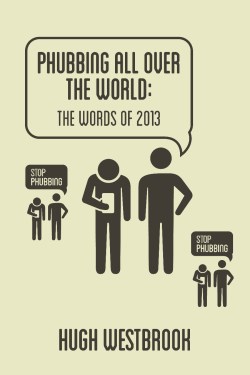
Phubbing also provides the backdrop to this year’s book of words. Following the publication of Eastwooding With the Mother Flame last year, I am delighted to announce the arrival of Phubbing All Over The World: The Words of 2013, which is available now as both an e-book and a paperback from Amazon.

English Influence Boosting Dutch

The latest update of the Dutch Van Dale dictionary demonstrates just how strong the influence of English has become across the Netherlands.

Last year, Wordability reported on how the popular messaging app WhatsApp had been recognised in the dictionary by getting its own verb. Twelve months on, the new list is redolent with words of an English bent.

So step forward 3D-Printer and Gamechangers, Factchecken and Pinpointen. I also like the word GeluksMachine, meaning Happiness Machine and coined by the country’s Prime Minister Mark Rutte. Clearly you wouldn’t be a geluksmachine if you were involved in Sukkelsex, defined as sex which is not focused on delivering top performance. I’m not sure I can think of an English equivalent of that. Maybe it is not something that is a problem over here.

It’s actually interesting to note just how many English-inspired words are getting into an increasingly wide variety of international dictionaries. Reports suggest that the Royal Spanish Academy will be adding Goglear, Tuitear and Guasapear, translated as Google, Tweet and WhatsApp, to the Spanish dictionary.

It has to be hoped that languages will continue to maintain their own identities as the world gets more global and technology terms in particular become more widespread and international. While it is far too soon to worry about the future of distinct languages, I wonder if we are witnessing the beginning of a very slow homogenisation.

The Phubbing Truth

It’s clearly not enough for phubbing to have emerged as the best new word of the year. It’s now got the best story as well.

Phubbing – phone snubbing – exploded internationally a couple of months ago. Publications across the globe, Wordability included, reported on how a Melbourne student had spotted the growing trend for people to pay more attention to their phones than other people in social settings and had set up a campaign and the Stop Phubbing website in response. The response to the story was so big that the word quickly became entrenched, and is now even on Oxford Dictionaries radar, as revealed exclusively to Wordability.

It now turns out that the story behind phubbing is a little different. It was in fact the brainchild of an advertising agency, designed to raise excitement about words and ultimately sell print copies of the new Macquarie dictionary.

The McCann agency actually created the word Phubbing during a brainstorming session in May 2012 – a video showing the process has now been released, and the efforts involved perhaps go some way towards demonstrating why the word is so damn good. A lot of brains gathered together to come up with it.

Stop Phubbing
Anti-Phubbing poster

Once the word was established, the website and social media tools swiftly followed. But it wasn’t until Australia’s Herald Sun ran a piece on phone etiquette that the word really took off. Alex Haigh, the alleged student behind the phenomenon but actually an account executive with McCann, contacted the paper to push the Stop Phubbing campaign, and the rest is viral history.

So now that the truth is out there, do I feel slightly hoodwinked? Well a little bit, yes. The romance of the original story has been lost, innocent student conquers the world with his great new word, washed away by advertising agency plans careful viral marketing campaign and worms its way into our consciousness.

But that analysis isn’t really fair. Regardless of its genesis, the rise of phubbing has still demonstrated all that is good about modern word formation. It filled a semantic gap, it’s a great word in its own right and its establishment confirms that the way that words evolve and become established is now utterly different to how it was even a few years ago.

And those behind it agree. The official video, ‘A Word is Born’, is a wonderful watch. If you don’t believe me, take a look for yourself, it is embedded at the bottom of this article.

Susan Butler, publisher and editor of Macquarie Dictionary, said: “The rise of phubbing as an original coinage has been a wonderful illustration of the process by which my word becomes your word becomes our word until finally it is a word which belongs to us all.” McCann executive director John Mascell added: “A Word is Born is a love story about words, and how incredible they are.”

And ultimately, that’s the great thing about this. Yes it comes from marketing, yes it might sell some dictionaries, but the phubbing story tells us so much more than that. It reminds us that language is always changing in new and wonderful ways.

Exclusive: New Words on Oxford Radar

The recent coverage of the inclusion of Twerking in Oxford Dictionaries’ latest online update showed just how much people genuinely care about the state of English and the words that we use.

But lexicography moves on, and the guardians of the Oxford lists are already looking at what the next new words to be included might be.

In an exclusive interview, Wordability spoke to Fiona McPherson, Senior Editor, Oxford Dictionaries, who revealed some of the words which are currently being tracked by lexicographers and which may be the ones which feature prominently in updates of the future. You can watch the full interview here:

So to summarise, the words she selected are:

Bacne – basically, acne on your back

Hatewatch – an old Wordability favourite, first identified last year. The practice of watching something you really don’t like, and chatting to your friends about it while hating it.

Dosant – a cross between a doughnut and a croissant

Legsie – hot on the heels of Selfie’s recent inclusion, a photograph you take of your own legs. One can only imagine where this will end, but politeness means I will decline to suggest it

Appisode – an online episode of a television show

Phubbing – one of the great new words of this year, a personal favourite and one which has already entered everyday use in my household. Phone snubbing, using your smartphone when you are supposed to be talking to someone else

Nocialising – See above

Meme – not a new word, but a new sense, as Meme, a cultural idea which passes from person to person, now starts to become a verb

Lolarious – LOL branches out into its own verb. Not sure what David Cameron’s version would become.

So that’s the latest list – now we sit back and wait to see which of them finally makes it all the way through the selection process.