The Perils of Wild Toileting

The most picturesque toilet I have ever visited was in the Himalayan Kingdom of Bhutan.

I appreciate that’s quite a random sentence with which to start a post on a language blog, but this morning I found myself musing on that hilltop location, where the greenery spread out for miles and the fluttering breeze made it the most tranquil place imaginable to spend a Ngultrum.

What brought this back to mind? Well it was  a news story centring on a dispute over the most remote public toilet in the UK mainland, and the rival claims of two Scottish conveniences to be the remotest loo in the UK. A slow news day, perhaps.

So why is there a Wordability interest? Very simply, the article discussed the whole concept of ‘wild toileting’, a phrase I was not previously familiar with and one which a search of the internet suggests is not in wide circulation, with only a smattering of mentions in a handful of places to represent its digital footprint.

With no official definitions to hand, it seems to have been used to mean ‘the practice of relieving yourself in wild locations and to the detriment of the surroundings’.

It’s a very entertaining term, and I guess there isn’t really a current alternative in English for this particular scenario, but it does seem a little superfluous. Most of us would still just talk about going to the loo, or whatever the vernacular is in our dialect of English, even though it’s a wild loo and isn’t made of porcelain. I’m not sure this is a term that is here to stay.

Mind you, I think it would be quite nice if wild toileting could come to mean something else, perhaps carrying out your business while screaming or shouting or thrashing about with an electric guitar. Alternatively, it could mean taking a scattergun approach to where your doings actually end up landing.

Or it could just be what you end up suffering when you’ve been been caught in a shitstorm.
Bitcoins Prove Their Worth

The words of the year choices keep on coming, and Australian lexicographers have fixed on a suitable candidate to take their accolade.

Bitcoin is undoubtedly a word which has found its place in the lexicon this year, despite having been created five years ago. This digital currency has seen its usage in both financial and linguistic senses explode this year, and so the Australian National Dictionary Centre has named it as its word of the year.

It’s undoubtedly a good choice. It is a word which has been significant in public consciousness this year in a way that it wasn’t previously, while measurable usage itself has shot up 1,000%, according to the Australian experts.

Bitcoin is probably not quite as popular as Selfie, which simply confirmed its Oxford Dictionaries choice this week by becoming the centre of Barack Obama’s world. I suspect Australian experts couldn’t choose Selfie as well once Oxford had given it the nod, though it included it in its shortlist for the year, along with Twerk, FOMO (Fear of Missing Out), Captain’s Pick and Microparty.

Sadly Phubbing did not make the shortlist, a shame considering it is a word of Australian origin. But when you consider that words like Bitcoin and Selfie are now being heralded as the words of the year, it means we may look back on 2013 as a year when we were self- and money-obsessed, which is not necessarily the most flattering reflection of ourselves.

Phubbing All Over The World

Choosing a word of the year for 2013 has been tough. When August started, there was absolutely nothing obvious. But that situation was just about to change.

When it comes to making the decision, words which are heavily searched for will always feature highly in my thinking, because that demonstrates an interest and usage by people in the English-speaking word.

But for me, a word of the year also has to say something about the year, be a commentary on the way society has been over the last 12 months. Last year I chose a range of words, with Eastwooding, Mother Flame and Ineptocracy providing a commentary on politics, the Olympics and the modern flowering of new terms.

I’m not sure that when historians look back on 2013, there will be an easy way to encapsulate it. Austerity and political strife have continued, but much the same as before. The major scandals, well they were really carried over from last year. Big sporting events, not really. I think Oxford Dictionaries had a similar issue when they chose their word of the year. Selfie was a good choice, because as well as its increasing usage in 2013, it also suggests a fracturing of society, that actually the thing that binds people together this year and describes the year is an obsession with self, and making sure everybody then knows about me, me, me. Social media binds us together, but is perhaps making us more isolated and individualistic.

And that is also behind my choice of Word of the Year. Phubbing first came to my attention in August. Reported as the brainchild of an Australian student, Phubbing suddenly started appearing everywhere. The word, a blend of Phone and Snubbing, describes the act of engaging with your mobile device rather than the person you are standing next to, real, physical social interaction replaced by virtual interaction with someone or something that isn’t really there. It struck me at the time as a brilliant word, fulfilling a semantic need and speaking accurately of a truly modern mode of behaviour. It summed up much of what defines 2013.

The truth behind the creation of Phubbing simply sealed the deal for me. It turned out that this was not a student initiative, it was actually a carefully crafted guerrilla marketing by a Melbourne agency, designed to sell dictionaries. They even released a video showing how a group of language experts had come together in 2012 to create the word and then try and seed it online to get it to take off. For me, this tale confirms everything I have always said about how the nature of language evolution has changed. Forget the fact it was created and consciously marketed – if the word hadn’t been any good and hadn’t been necessary, it couldn’t have taken off. But the way that it did, the fact that it is consistently searched for and read about on Wordability, the way it has just slipped into normal vocabulary, especially in my household, simply affirms that it is the word of the year.

Phubbing All Over The World

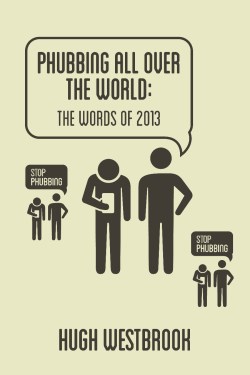
Phubbing also provides the backdrop to this year’s book of words. Following the publication of Eastwooding With the Mother Flame last year, I am delighted to announce the arrival of Phubbing All Over The World: The Words of 2013, which is available now as both an e-book and a paperback from Amazon.

Run Away From the King of Gore

I always enjoy a good dinosaur discovery story, because a new dinosaur inevitably means a new word.

The latest finding in the world of paleontology is an ancient ancestor to Tyrannosaurus Rex. The Lythronax argestes was found in Utah. It is estimated that it lived 80m years ago, was eight metres long, weighed two and a half tonnes and ate copious quantities of meat with its vast array of teeth.

While the word Lythronax automatically goes into the lexicon as a new type of dinosaur, I expect the translation of the Latin will catch on in popular consciousness. After all, referring to a dinosaur as The King of Gore is far better for headline writers, children and makers of films about recreating dinosaurs from strands of DNA.

The Rise of the Tuhao

It’s a fair bet that most readers of Wordability will not spend much time thinking about new words in Chinese. But when that word starts to become a social media phenomenon, it’s time to take notice of it and wonder whether it will cross over into the lingua Franca of the Internet as a whole.

Tuhao has appeared millions of times across Chinese social media. The word is actually more than 1,500 years old and means rich landowner. However it is now used to refer to the newly wealthy, the nouveau riche, to bring in yet another language. It has been commandeered in a derogatory way for these people, who flaunt their freshly acquired fortunes with displays of conspicuous consumption, gaudy jewellery, and the latest gadgets, especially the gold iPhone. The words Bling and Tuhao never seem to be far away from one another.

The word, comprised of ‘tu’ meaning dirt and ‘hao’ meaning splendour, got its social media kick from a joke which went viral. A young man asks a Zen master, “I’m wealthy but unhappy. What should I do?” The Zen master responds, “Define ‘wealthy.’ ” The young man answers, “I have millions in the bank and three apartments in central Beijing. Is that wealthy?” The Zen master silently holds out a hand, inspiring the young man to a realisation: “Master, are you telling me that I should be thankful and give back?” The Zen master says, “No … Tuhao, can I become your friend?”

As Buddhist jokes go, I prefer the one about the pizza. But leaving that aside the term has now become a Chinese Internet staple as a way of referring to this particular social trend.

It is very much part of a development in Chinese culture and would not necessarily apply everywhere, but its a neat and effective piece of linguistic shorthand that is perfect for modern methods of communication.

As Chinese presence increases globally, it will be interesting to watch whether linguistic developments such as this cross over into wider usage. Will a domain which has hitherto been dominated by English neologisms starts to become yet another area where Chinese influence starts to dominate?

Is Cultuphobia A New Concern?

An interesting new word has been coined in America to describe a social phenomen which seems to be the antithesis of globalisation and our increasing merging of cultures. Cultuphobia is defined as ‘the fear that another person’s culture is taking over your own’.

It’s a clever coining by writer Ruben Navarrette, who was inspired to come up with the term after a televisual experiment. To mark the launch of English-language, Latino-targeted television network Fusion, the hosts of Spanish-language breakfast show Despierta America appeared on Good Morning America, with talent from that programme going in the opposite direction.

What appeared to be an entertaining cross-cultural experience, enjoyed by all who took part, turned instead into an outpouring of online anger, with many fans of Good Morning America furious at what had happened to their favourite show and demanding that it shouldn’t happen again.

Navarrette used this as a way of introducing Cultuphobia as a term, saying that it demonstrated the fear that people have of a new culture coming in and changing the established order of things.

I think it is an interesting attempt to introduce a new word, but is it really necessary? There are lots of other terms that cover issues of people disliking and fearing other cultures. History has also shown us many occasions when the fear of another culture’s influence has seen the dominant culture abuse and ultimately drive out that smaller culture, so it is not a new concept.

I think cultuphobia covers an interesting nuance of meaning, but I am not sure it is distinctive enough to really establish itself as a word that defines something appreciably different. Nevertheless, it does remind us that even though the world is changing, and cultures are influencing each other an increasing amount, there will always be people for whom this is not a positive development.

English Influence Boosting Dutch

The latest update of the Dutch Van Dale dictionary demonstrates just how strong the influence of English has become across the Netherlands.

Last year, Wordability reported on how the popular messaging app WhatsApp had been recognised in the dictionary by getting its own verb. Twelve months on, the new list is redolent with words of an English bent.

So step forward 3D-Printer and Gamechangers, Factchecken and Pinpointen. I also like the word GeluksMachine, meaning Happiness Machine and coined by the country’s Prime Minister Mark Rutte. Clearly you wouldn’t be a geluksmachine if you were involved in Sukkelsex, defined as sex which is not focused on delivering top performance. I’m not sure I can think of an English equivalent of that. Maybe it is not something that is a problem over here.

It’s actually interesting to note just how many English-inspired words are getting into an increasingly wide variety of international dictionaries. Reports suggest that the Royal Spanish Academy will be adding Goglear, Tuitear and Guasapear, translated as Google, Tweet and WhatsApp, to the Spanish dictionary.

It has to be hoped that languages will continue to maintain their own identities as the world gets more global and technology terms in particular become more widespread and international. While it is far too soon to worry about the future of distinct languages, I wonder if we are witnessing the beginning of a very slow homogenisation.

The Rise of the Mega-Fire

The bushfires raging in Australia have ravaged large parts of New South Wales. They also serve to highlight that sometimes a theoretical new word can become real in devastating ways.

The term Mega-Fire appears to have been coined two years ago, and though some fires began to be described in this way immediately, it was more of a theory than anything else. A report from the United Nations Food and Agriculture Organization used the term, and said that the definition is more to do with the impact on people and the environment than their specific size.

But in many ways, it was just a theory then. Robert Keane, a research ecologist at the US Forest Service’s Missoula Fire Sciences Laboratory, said: “Mega-fire is more of a concept than a construct. What I interpret it to mean is not only is it large, but it affects a lot of people.”

Now of course it is anything but theoretical, as fire continues to take hold in Australia and the term Mega-Fire is all over the headlines.

What I think is particularly interesting is that this is really a technical term and will continue to be used to describe a particular scale and type of fire. At first, it was easy to assume it was a shorthand coined by journalists to boost headlines. But it isn’t, and is something that has a specific meaning for those whose job it is to fight and contain such disasters.

If our climate is changing and fires are going to get worse, this year will not be the only time that mega-fires dominate the news.

Will De-Americanization Lead To Chinafication?

If history teaches us anything, it is that the world order changes over time, and yesterday’s superpower is today’s underling. And as we get deeper into the 21st century, so the growing influence of China reminds us that the world in 100 years’ time may have a very different structure of influence to that which exists at present.

So it is interesting to see a linguistic nod in that direction emerging from Chinese sources. The Xinhua news agency published an opinion piece on the US Government shutdown, and posed the question of whether it was time to prepare for a “De-Americanized” world.

It’s not for Wordability to analyse the political and economic arguments surrounding this article, nor to comment on the myriad responses that the piece has garnered. Instead, I simply comment on the amount of attention this has drawn, the number of times the word de-Americanized, or de-Americanization, has now been used in response, and congratulate the Chinese author on coining a simple but effective term to really kick-start the debate and encapsulate the essence of the issue.

This demonstrates once again that in the field of political altercation, the side that comes out on top is sometimes the one that find the right term and defines the debate by controlling the language of the headlines. As the years move on, we may see de-Americanization becoming increasingly used as a term, and it may become the standard word for describing how power is shifting halfway round the world.

Americanization features in all major online dictionaries to mean making something American in character . Its newly-formed antonym will have to wait its turn to take its place. But as it gains acceptance, I wonder if a Chinese equivalent of Americanization will start to be used. Chinafication anybody?

Don’t Give Thanks for Thanksgivukkah

By a quirk of the calendar, Thanksgiving this year falls this on the first night of the Jewish festival of Chanukah.

Both are movable feasts in terms of their specific English date. Thanksgiving is celebrated on the fourth Thursday in November.  Chanukah is on a fixed date in the Jewish calendar, but that calender itself is a complex lunar and solar amalgam, where the lunar months are regularly supplemented by an extra month in order to keep festivals in line with their place in the solar cycle.

This complex arrangement means that Hebrew and English dates coincide once every 19 years, though even these are not exact as there can still be slight adjustments either way of a day or two.

But what it really means is that Chanukah is really only early enough once every 19 years to land square on with Thanksgiving, and even then, it would have to be a Thursday. So how rare is this? Well, so rare that it hasn’t happened in over 100 years, and even though it is slated to happen again in 2070 and 2165, it will then be many millennia before the joint celebration falls again. And I dare say that society may not be celebrating Thanksgiving and Chanukah in 70,000 years’ time, though that’s a musing for a different blog altogether.

I digress. The reason this has piqued Wordability’s interest is that the confluence has created something which is being regarded almost as a new festival, one where the traditions and food of both will be combined in one glorious night. And every new festival deserves a new word. So step forward Thanksgivukkah.

Frankly, the best thing about this is that this occurrence is so rare, so this pretty ugly portmanteau will soon retreat into the realms of linguistic obscurity and history where it so richly deserves to dwell. The problem with it is that it just sounds ugly and doesn’t trip off the tongue. And is it really necessary? No, I don’t think so. Chanukah and Christmas meet often enough, nobody who marks both feels a need for a new word. Same with Passover and Easter. Frankly I am glad that most festivals stay in broadly fixed slots throughout the year to avoid more of these linguistic aberrations.

So happy Thanksgivukkah to all who are celebrating – but please, just ditch the name.