Losing The Taste For Quenelles

I’m a bit of a sucker for competitive cookery programmes. One thing that is always entertaining is the quirks of the contestants and the fripperies they often try to get into their food. In particular, I remember one contestant who was obsessed with trying to get a quenelle into everything.

In that context, quenelle is an egg-shaped mound of food, and is normally an accompaniment to a main course, or perhaps some ice cream, delicately shaped using two spoons before being added to the plate to give it some apparent finesse. So entertaining did we find this as a family, that my eight-year-old daughter starting forming quenelles of cream cheese to put with her crackers. And in gastronomy, quenelle has a bigger relative, a dish of a creamed protein combined with breadcrumbs and egg and served as a more substantial dish.

But quenelles are no longer funny. No, Premier League footballer Nicolas Anelka and his French comedian buddy Dieudonne have seen to that. At the start of 2014, quenelle was only really known to English speakers from the usage described above. But once Anelka had adopted the quenelle pose to celebrate a goal for West Brom against West Ham, its racially charged meaning started to dominate headlines everywhere.

The gesture, created by Dieudonne in 2005, is an inverted Nazi salute with the opposite hand touching the shoulder. It is derived from its edible cousin and harks back to when Dieudonne said he wanted to insert a quenelle up the backside of Zionists. But his subsequent claims that this is an anti-establishment, rather than an anti-semitic, gesture, seem hollow, given the subsequent usage of the action outside synagogues or Holocaust memorials.

The usage of the quenelle has been growing in France, but it still took its adoption by Anelka to propel it to prominence and a place in the English language. And the debate over the true meaning of it seems irrelevant now. Whether or not Anelka’s usage of it was innocent, and whether or not Dieudonne means it to be truly racially offensive or not, it now is. The quenelle gesture is now perceived by people in England as anti-semitic and it will justifiably become something that people should be vilified for using, without allowing them to hide behind an argument about the nuances of its actual intention.

The quenelle has changed its meaning forever with English speakers, and the next time I watch a cookery show, it will be interesting to see if the producers have seen fit to quietly move them off the table.
Felfies – The New Breed on the Farm

The linguistic flexibility of the word Selfie seemingly knows no bounds. Not content with being a word of the year, Selfie is now showing itself as flexible and changeable, with multiple variations being coined to describe the seemingly infinite variations of self-portrait that are now emerging.

The first alternatives focused on different parts of the body being pictured, with Legsie being mooted as one specific example which was taking off. The latest evolution is derived from those taking the pictures themselves, and the one that has attracted significant attention is self-portraits taken by farmers, otherwise known as Felfies.

The home for Felfies is the Farmingselfies website, set up by farmer William Wilson as a way of putting a face to the many farmers whose hard and isolated lives feed so many people round the world. It’s unlikely he envisioned the attention that his move would bring. But social media loves a picture of an animal, and as farmers started to submit their snaps of them together with the other inhabitants of their farms, so the concept and the term Felfie itself began to grow and trend.

From a linguistic point of view, I have to wonder whether the never-ending spread of selfies means an increasing number of variants for the English-language to contend with. If other professions jump on the bandwagon, will they spawn their own versions? Will bakers be taking Belfies and shelf-stackers snapping Shelfies before too long? And pity the poor sailors, who cannot claim Selfies as their own.

Selfie recently topped the Lake Superior State University annual list of banished words. It is fair to see that if these alternative versions continue to emerge, a whole gamut of Selfie progeny could be topping the list in 12 months’ time.

Sexting Given French Twist

It’s been an interesting year for sex in France. Linguistically, at any rate. Earlier this year, the word Galocher for French Kiss finally made it into the Petit Robert dictionary. And now another saucy term has found itself in the headlines.

As part of its efforts to keep the French language pure, English terms are frowned on, and L’Académie Française, France’s official language authority, has now published a list of the French alternatives to Anglicised expressions with are creeping into the language.

The proposed variant to Sexting has garnered most attention, with Textopornographie put forward as the new word in the official government list. I don’t know about you, but I know which one sounds more lurid and has a certain je ne sais pas.

There are some other interesting terms in the list, such as Vidéoagression for Happy Slapping, which again sounds more ominous than its English equivalent, or Surtransposition for Gold Plating.

As English-inspired technology drives word evolution, there will be more of this. Earlier this year Wordability reported on the replacing of Hashtag with Mot-Dièse, and as this latest story shows, this trend will only continue. Or as the French will come to say, That’s Life.

The Perils of Wild Toileting

The most picturesque toilet I have ever visited was in the Himalayan Kingdom of Bhutan.

I appreciate that’s quite a random sentence with which to start a post on a language blog, but this morning I found myself musing on that hilltop location, where the greenery spread out for miles and the fluttering breeze made it the most tranquil place imaginable to spend a Ngultrum.

What brought this back to mind? Well it was  a news story centring on a dispute over the most remote public toilet in the UK mainland, and the rival claims of two Scottish conveniences to be the remotest loo in the UK. A slow news day, perhaps.

So why is there a Wordability interest? Very simply, the article discussed the whole concept of ‘wild toileting’, a phrase I was not previously familiar with and one which a search of the internet suggests is not in wide circulation, with only a smattering of mentions in a handful of places to represent its digital footprint.

With no official definitions to hand, it seems to have been used to mean ‘the practice of relieving yourself in wild locations and to the detriment of the surroundings’.

It’s a very entertaining term, and I guess there isn’t really a current alternative in English for this particular scenario, but it does seem a little superfluous. Most of us would still just talk about going to the loo, or whatever the vernacular is in our dialect of English, even though it’s a wild loo and isn’t made of porcelain. I’m not sure this is a term that is here to stay.

Mind you, I think it would be quite nice if wild toileting could come to mean something else, perhaps carrying out your business while screaming or shouting or thrashing about with an electric guitar. Alternatively, it could mean taking a scattergun approach to where your doings actually end up landing.

Or it could just be what you end up suffering when you’ve been been caught in a shitstorm.

The Rise of the Tuhao

It’s a fair bet that most readers of Wordability will not spend much time thinking about new words in Chinese. But when that word starts to become a social media phenomenon, it’s time to take notice of it and wonder whether it will cross over into the lingua Franca of the Internet as a whole.

Tuhao has appeared millions of times across Chinese social media. The word is actually more than 1,500 years old and means rich landowner. However it is now used to refer to the newly wealthy, the nouveau riche, to bring in yet another language. It has been commandeered in a derogatory way for these people, who flaunt their freshly acquired fortunes with displays of conspicuous consumption, gaudy jewellery, and the latest gadgets, especially the gold iPhone. The words Bling and Tuhao never seem to be far away from one another.

The word, comprised of ‘tu’ meaning dirt and ‘hao’ meaning splendour, got its social media kick from a joke which went viral. A young man asks a Zen master, “I’m wealthy but unhappy. What should I do?” The Zen master responds, “Define ‘wealthy.’ ” The young man answers, “I have millions in the bank and three apartments in central Beijing. Is that wealthy?” The Zen master silently holds out a hand, inspiring the young man to a realisation: “Master, are you telling me that I should be thankful and give back?” The Zen master says, “No … Tuhao, can I become your friend?”

As Buddhist jokes go, I prefer the one about the pizza. But leaving that aside the term has now become a Chinese Internet staple as a way of referring to this particular social trend.

It is very much part of a development in Chinese culture and would not necessarily apply everywhere, but its a neat and effective piece of linguistic shorthand that is perfect for modern methods of communication.

As Chinese presence increases globally, it will be interesting to watch whether linguistic developments such as this cross over into wider usage. Will a domain which has hitherto been dominated by English neologisms starts to become yet another area where Chinese influence starts to dominate?

Is Cultuphobia A New Concern?

An interesting new word has been coined in America to describe a social phenomen which seems to be the antithesis of globalisation and our increasing merging of cultures. Cultuphobia is defined as ‘the fear that another person’s culture is taking over your own’.

It’s a clever coining by writer Ruben Navarrette, who was inspired to come up with the term after a televisual experiment. To mark the launch of English-language, Latino-targeted television network Fusion, the hosts of Spanish-language breakfast show Despierta America appeared on Good Morning America, with talent from that programme going in the opposite direction.

What appeared to be an entertaining cross-cultural experience, enjoyed by all who took part, turned instead into an outpouring of online anger, with many fans of Good Morning America furious at what had happened to their favourite show and demanding that it shouldn’t happen again.

Navarrette used this as a way of introducing Cultuphobia as a term, saying that it demonstrated the fear that people have of a new culture coming in and changing the established order of things.

I think it is an interesting attempt to introduce a new word, but is it really necessary? There are lots of other terms that cover issues of people disliking and fearing other cultures. History has also shown us many occasions when the fear of another culture’s influence has seen the dominant culture abuse and ultimately drive out that smaller culture, so it is not a new concept.

I think cultuphobia covers an interesting nuance of meaning, but I am not sure it is distinctive enough to really establish itself as a word that defines something appreciably different. Nevertheless, it does remind us that even though the world is changing, and cultures are influencing each other an increasing amount, there will always be people for whom this is not a positive development.

The Rise of the Mega-Fire

The bushfires raging in Australia have ravaged large parts of New South Wales. They also serve to highlight that sometimes a theoretical new word can become real in devastating ways.

The term Mega-Fire appears to have been coined two years ago, and though some fires began to be described in this way immediately, it was more of a theory than anything else. A report from the United Nations Food and Agriculture Organization used the term, and said that the definition is more to do with the impact on people and the environment than their specific size.

But in many ways, it was just a theory then. Robert Keane, a research ecologist at the US Forest Service’s Missoula Fire Sciences Laboratory, said: “Mega-fire is more of a concept than a construct. What I interpret it to mean is not only is it large, but it affects a lot of people.”

Now of course it is anything but theoretical, as fire continues to take hold in Australia and the term Mega-Fire is all over the headlines.

What I think is particularly interesting is that this is really a technical term and will continue to be used to describe a particular scale and type of fire. At first, it was easy to assume it was a shorthand coined by journalists to boost headlines. But it isn’t, and is something that has a specific meaning for those whose job it is to fight and contain such disasters.

If our climate is changing and fires are going to get worse, this year will not be the only time that mega-fires dominate the news.

Don’t Give Thanks for Thanksgivukkah

By a quirk of the calendar, Thanksgiving this year falls this on the first night of the Jewish festival of Chanukah.

Both are movable feasts in terms of their specific English date. Thanksgiving is celebrated on the fourth Thursday in November.  Chanukah is on a fixed date in the Jewish calendar, but that calender itself is a complex lunar and solar amalgam, where the lunar months are regularly supplemented by an extra month in order to keep festivals in line with their place in the solar cycle.

This complex arrangement means that Hebrew and English dates coincide once every 19 years, though even these are not exact as there can still be slight adjustments either way of a day or two.

But what it really means is that Chanukah is really only early enough once every 19 years to land square on with Thanksgiving, and even then, it would have to be a Thursday. So how rare is this? Well, so rare that it hasn’t happened in over 100 years, and even though it is slated to happen again in 2070 and 2165, it will then be many millennia before the joint celebration falls again. And I dare say that society may not be celebrating Thanksgiving and Chanukah in 70,000 years’ time, though that’s a musing for a different blog altogether.

I digress. The reason this has piqued Wordability’s interest is that the confluence has created something which is being regarded almost as a new festival, one where the traditions and food of both will be combined in one glorious night. And every new festival deserves a new word. So step forward Thanksgivukkah.

Frankly, the best thing about this is that this occurrence is so rare, so this pretty ugly portmanteau will soon retreat into the realms of linguistic obscurity and history where it so richly deserves to dwell. The problem with it is that it just sounds ugly and doesn’t trip off the tongue. And is it really necessary? No, I don’t think so. Chanukah and Christmas meet often enough, nobody who marks both feels a need for a new word. Same with Passover and Easter. Frankly I am glad that most festivals stay in broadly fixed slots throughout the year to avoid more of these linguistic aberrations.

So happy Thanksgivukkah to all who are celebrating – but please, just ditch the name.

You Say TomTato

If I told you that somebody had invented a plant which grows both tomatoes and potatoes, you’d think I was making it up. Or ask me what the point of it was.

But the TomTato plant has indeed gone on sale in the UK. Plant one and you will get a bumper crop of sweet tomatoes on the top half, while the roots will sprout copious potatoes.

I have to say that I find the idea of this kind of grafted plant somewhat peculiar and it leaves me wondering what linguistic delights we may have to look forward to in the future. Brocberries, auberfigs, caulicumbers anyone?

For now though we will simply have to enjoy a plant which can yield us both chips and ketchup simultaneously.

Is it a Fruit or is it a Monster?

When I read that supermarket group Tesco was going to start stocking the world’s largest avocado, my first thought was that the word for it must already be in wide usage. OK, that was my second thought. My first thought was Yum.

But putting my greed to one side, I quickly Googled the word and discovered to my surprise that Avozilla does not appear to have been in any kind of common currency prior to this announcement. It’s not even in Wikipedia, and everything that’s anything is in Wikipedia. Except for Wordability of course, but that’s just a matter of time.

All of which makes me slightly sceptical about the Avozilla. The way it has been hyped and covered suggests it is a new variety of avocado. The press release trumpets that the fruit “is extremely rare and comes from just four trees grown by one of the world’s biggest suppliers of avocados, in South Africa.” Tesco salad buyer Emma Bonny said: “The Avozilla has a fantastic taste with a rich, juicy, buttery texture, and creamy flavour.” As well as its size, the difference in skin colour and texture are also used to highlight that it is a different variety.

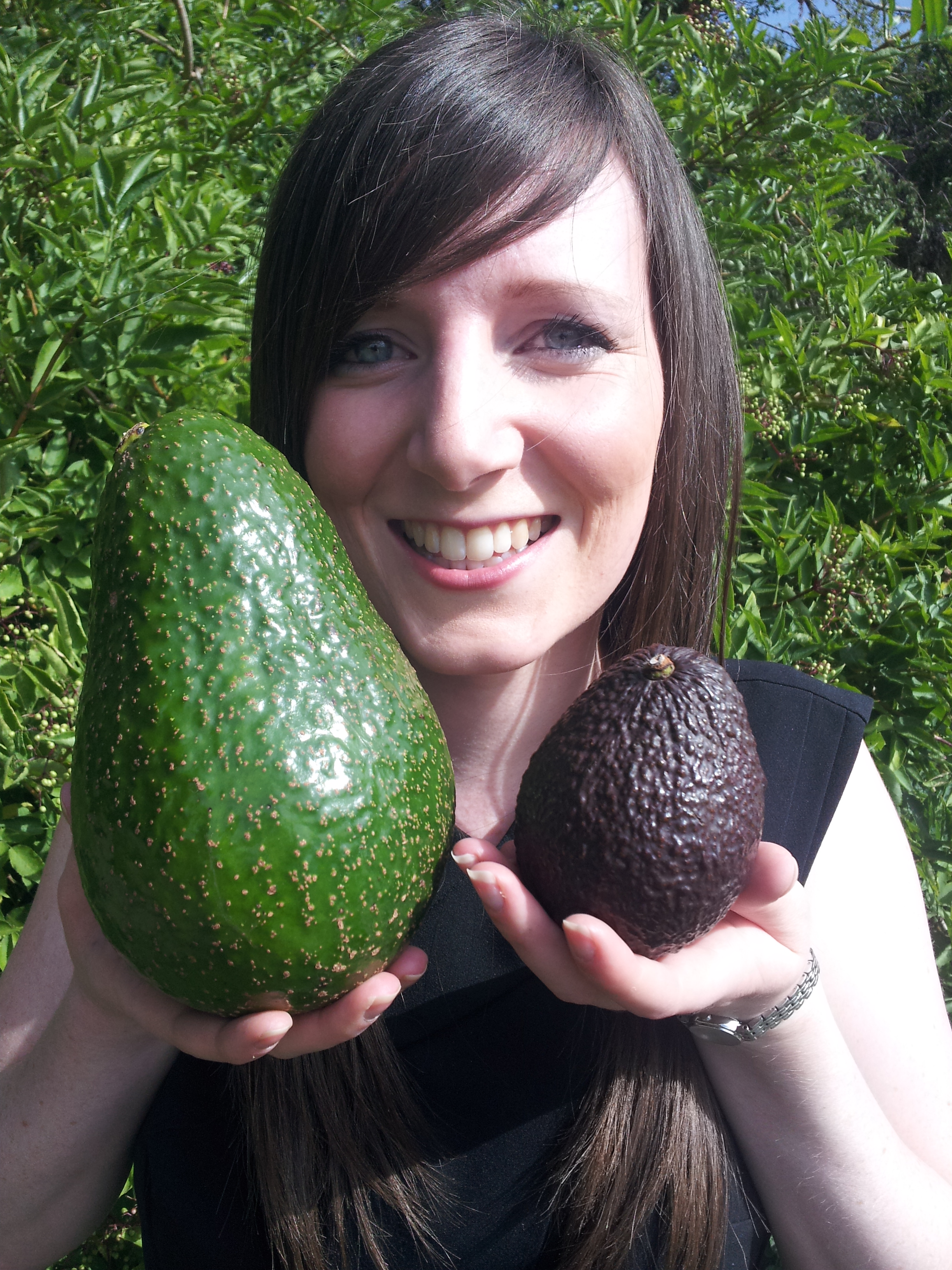
Avozilla
Tesco salad buyer Emma Bonny with an Avozilla

Call me cynical, but isn’t this basically just a big avocado? Don’t you already get some avocados with dark skin and some with light skin? Aren’t all the best avocados buttery and creamy? Is this really a new variety?

The answer is surely in the word itself, and not just the fact that it appears nowhere else except in reference to this launch. New varieties are often amalgams of the different fruits which they represent, such as a Papple, or just some other word or scientific term altogether. But the only derivation I can think of for the Avozilla is Godzilla, and that the -zilla suffix is being used here to denote its monstrous size.

Not a normal way of naming varieties and not one I see catching on beyond the world of marketing spin. Applezilla anyone?