The Line Between Bleisure And Pain

Sometimes, a new word is so bad, it really shouldn’t be given a new life. But people will still resurrect it, hoping that this time, it will stick.

Bleisure is one such word. An ugly combination of business and leisure, it describes a type of travelling which combines, well, business and leisure. And so the Accor group has announced a revamping of its Pullman brand, with an emphasis on Bleisure travellers, giving a more luxurious experience to those travelling on business.

It seems that people have been trying to get this term to take off for at least three years, and the fact that it is still being presented as a new word in this latest release confirms that it has simply not gained any traction at all. Hotel chains were pushing it in advertorials in 2010, and others were trying to get in on the act the same year.

However, when Bleisure was submitted to Collins dictionary last year as a possible word for inclusion, it was rejected on the grounds that there was very limited evidence of it actually being used.

So while you clearly can’t keep any idea down forever in the world of marketing, the history of Bleisure travel so far suggests that it may not have much of a future, and hopefully this is a word that will disappear into the linguistic oblivion it deserves.

Happy To Be Sharenting

When my son was born last November, I was very conscious that he had arrived into an era very different to that of his elder sister, even though they are only a few years apart. That difference was social media.

So while I could announce my daughter’s birth in 2005 by email, and host some photos on specialised websites, that was the extent of her early digital footprint. Fast forward to 2012 and I kept on thinking about the fact that I was now having a Facebook baby, with scan pictures just the start of the tumult I subsequently unleashed.

Given that I had commented many times on this difference, I should probably have recognised with my Wordability hat on that this new concept would inevitably require a new word. But now that it has come along, I find that I don’t like the term Sharenting at all.

It’s a clever coinage, and actually encapsulates the meaning well – parenting and sharing at the same time. But I can’t help feeling there is something pejorative about it, something slightly sneery. People like to criticise others for the way that they parent, and you could easily imagine somebody gossipping about those who are sharenting as if it is some kind of fault.

I’m also not convinced anybody will really use it conversation. It is a great word for journalists and the media to use to discuss the phenomenon, but as for the rest of us, I suspect we will just note that people are sharing information about their offspring on social media in much the same way they used to share information, albeit not as quickly and not with as wide a circle. People have always shown off pictures, boasted about achievements and nattered to anyone who will listen about how their children are doing. Social networks simply allow people to do what they have always done, just on a quicker and larger scale.

Sharenting as a concept is going nowhere, and I suspect the word is here to stay. It’s just I don’t think you will hear many people saying it.

Say Goodbye to Fergie Time

As the football world bids farewell to Sir Alex Ferguson this weekend, it is worth nothing that it is not only his contribution to football that should be celebrated.

When he first shipped up at Old Trafford in 1986, nobody could have predicted that he would last until 2013. Equally, nobody would have believed you if you had said we would laud his contribution to the English Language on his departure.

But Sir Alex’s contribution to neologisms is legend. Perhaps his most famous phrase is ‘Squeaky Bum Time’, a phrase that refers to the sharp end of the football season and the nerves that emerge as the tension increases. It dates back 10 years and was given official recognition in 2005, while it is now a standard part of the lexicon for all fans when discussing any matter to do with the season’s conclusion.

The other time connection to the outgoing boss is Fergie Time, a rather pointed term not coined by the great man. This refers to the perception that Manchester United get more time added on at the end of games when they are losing than other teams, and that they often make use of this temporal largesse. Analysis has suggested that there is no basis in fact for this asssertion, but all football fans enjoy a good moan about bias being shown to rival teams, so the phrase will remain, even though Fergie himself has gone.

But you would never berate Sir Alex over these issues. After all, he is legendary in the football world for dishing out the hairdryer treatment, a particularly loud mode of berating players for not performing at their best.

So as Sir Alex disappears into the sunset, remember that it is not only the football world he has changed. He has also had a demonstrable effect on the language that we speak.

Let’s Go Showrooming

I am not a fan of going shopping. For me, it is functional, get in there, get what you need, and get out again. A browse round a bookshop is fun, of course, but that’s about it.

The rise of online shopping has changed all of that. On the one hand, you don’t need to go shopping, you can just do it on the computer. On the other, you can go shopping any hour of day or night, you are no longer spared just because the doors have been locked.

Now I’m sure we have all been guilty of going into shops, checking out a price, whipping out our phone to compare it to online competitors and then leaving to make that purchase from our living room. Maybe what we didn’t know was that we were ‘showrooming’.

Showrooming is defined as doing precisely what I have described, examining goods in a physical shop and then buying them cheaper online. When I say defined, of course, I don’t mean officially. Showrooming has not yet made it to the official annals of most dictionaries.

I am in a bit of a quandary about this word. I have often said that words emerge when there are new trends in need of a descriptor, and there is no doubt that this is a new activity and there is currently no adequate word in the language to encapsulate it. It is just that I can’t see anybody ever saying it. It feels like a term invented for the written media, for headline writers or analysts to use. Surely people will simply continue to say they are going shopping, even if they have no intention of actually buying anything while out. Surely people will use longer sentences if they want to go into details about what they have done, rather than using this particular word.

So while showrooming is likely to stick around for those who write about this phenomenon, I think it is unlikely to enter common speech for those who are actually doing it.

QWERTY Overtyped By KALQ

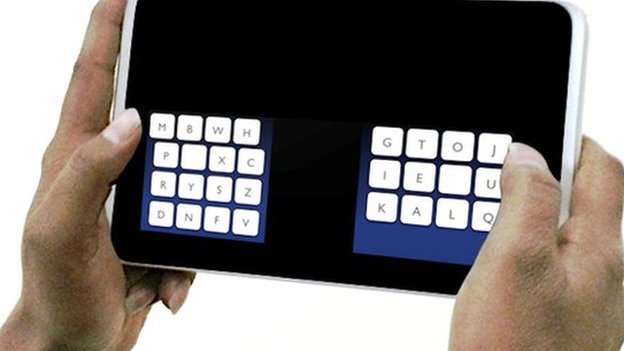
There have been many attempts over the years to redesign the traditional keyboard. Thus far, QWERTY has reigned supreme, and so a string of letters arranged for ease of typing has become the word by which the keyboard is known.

The latest challenger to this is designed with touch screens in mind and similarly takes its name from a string of letters in the arrangement, this time the opposite corner.

KALQ Keyboard

The KALQ keyboard is probably the only name that could have been chosen based on the arrangement, as frankly all the other lines produce unpronounceable gibberish, though I like the idea of the GTOJ keyboard challenging for typing supremacy. I wonder if the researchers made sure that there was at least one line which could be spoken to ensure their keyboard had a chance of being publicised.

Mind you, the combined brains of the University of St Andrews, the Max Planck Institute for Informatics in Germany and Montana Tech in the US aren’t entirely obsessed with simplicity. They described the old design as trapping people in “suboptimal text entry interfaces”. Well quite.

Another thing that has emerged from this story is the phrase ‘thumb typing’ which is being treated as something linguistically new by the media, a fair point since it doesn’t seem to feature in online dictionaries yet. It obviously means typing with your thumb.

As technology evolves, who knows whether this mode of typing will become the new default, and thumb typing will simply become known as typing in the future, with finger typing then being needed as the word for the old fashioned sort. And as new devices come on the market, who can say what parts of our body we might end up typing with. And that could open up a whole new chapter of neologisms.

Put An Apodment In Your Master Bedroom

A couple of interesting developments in the housing market in the United States are set to make subtle changes to the English language.

In Seattle, there have been efforts to introduce a new kind of micro-housing as a way of saving space. Apodments, as they are called, are small living spaces in a block with access to shared kitchens – the perfect solution it would seem for young people looking for a cheap way to live.

But they are not so perfect for many in the city, with protest forming against plans to develop these Apodments. With Seattle seemingly the only place where they might spring up, their rejection might see a natty new housing word stifled at birth. But never say never – if Seattle can change the world of coffee drinking, then it may yet revolutionise apartment dwelling.

Meanwhile on the other side of the country, the Washington Business Journal has reported on a well-established housing term that could be set to bite the dust. According to a survey, an increasing number of housebuilders in the area are ditching the term ‘Master Bedroom’ because they say it is sexist or has connotations of slavery. ‘Owner’s Bedroom’ is being used instead.

Ignore the fact that owner’s bedroom simply doesn’t feel like it means the same thing – master bedroom implies the main room, owner’s bedroom is ultimately any bedroom, because the owner, logically, owns all of them. I agree with others who feel that this is political correctness gone potty. Yes, there are elements in English which are inherently sexist, and yes, there are times when it is important to be aware of that and change it where necessary.

But I remember years ago working on the subject of ‘unequal lexical pairs’ and considering ‘Master’ and ‘Mistress’ as examples where the feminine form of the word has wildly different meanings to the masculine one. In particular I suggested that ‘Mistress of Arts’ implied you’d be paying for them. ‘Mistress Bedroom’ doesn’t sound much better. So there are issues with the word Master. But I don’t think they really apply with Master Bedroom. I think that it’s a phrase where the male-ness of the word Master is actually irrelevant. For me, it simply means the biggest room, the gender question has simply never struck me as a problem.

So I see no reason for the phrase Master Bedroom to disappear. Unless you are buying an Apodment, of course.

Keep Your Eyes Out For Glassholes

There seems little doubt that when Google started promoting Glass, their wearable computer, they had one eye on the effect they would have on the English language. After all, the term Glass Explorers has already been coined for the early trailblazers, and doubtless the technology giants would be hoping for further linguistic developments in the months to come.

But the problem with introducing something new is that the pesky public does have a habit of coining epithets of its own. And so it is with Google Glass, and the early perception that some of the initial users are behaving in ways that are more than slightly irritating. Being Glassholes, in fact.

It’s early days for the word, but its usage is already being noted and is spreading, and seems very likely to stick. Why is it so successful? Basically, it’s because it’s funny. I mentioned it to somebody the other day and he burst out laughing. It takes that very English type of wordplay of rhyming one word with another, a trick which is always successful, and creates a perfect play on words. It encapsulates a huge amount of meaning in a very short space.

And wouldn’t it be great if the idea of glass rhyming with its buttock-related cousin could be extended to other well-known words and phrases. You’d never think the same way about a ‘glass half full’ person. People who ‘live in glass houses’ would have a very different kind of lifestyle. Even an innocent ‘glass of milk’ would be consumed in an altogether different manner. Anyway, enough. Time to stop glassing around and publish this.

How to Spend Your Bitcoin

Let’s immediately get one thing straight. If you’ve come here for an in-depth financial analysis of Bitcoins, you’re in the wrong place. But welcome anyway, have a look around. I’m sure you’ll find these offerings on financial haircuts, Greece or Fiscal Cliffs were worth the visit.

If you’re here for the more usual Wordability fare of finding out about new words, then let me tell you more. Bitcoin is not a new word per se, having first been used at the start of 2009. It emerged from research published the year before by Japanese developer Satoshi Nakamoto. But despite its history, the word is certainly novel for many of us, and its sudden emergence into the mainstream may see it being recognised as one of the words of the year.

So what is a Bitcoin? Basically, if I am understanding it correctly, it is a form of electronic currency, protected by a complex algorithm and limited to a maximum number of units. The reason you might have now heard of it is that investors are suddenly ploughing into them as the next potentially safe haven for their cash. Forget gold, it is said, Bitcoins are the new investment bling.

With prices rocketing from a few dollars to over $140, news outlets have been falling over themselves to explain them and debate them, while hackers have already been out to try and destroy them.

I clearly don’t profess to know what the future of Bitcoin is, and whether it will prove to be an investment flash in the pan or the future of money. But either way, it is now enjoying its moment in the sun, meaning that this is the year in which its place in the financial lexicon will be secured.

Look Through The Eyes of Glass Explorers

I once did a temping job in an office which concentrated on building and maintenance projects. I always particularly enjoyed dealings with the Electrical Foreman or the Mechanical Foreman. This was nothing to do with their personalities or the nature of the work I had to do. It was simply that I liked their job titles, and imagined them as either built of metal or plugged in as they went about their days.

Google’s new term Glass Explorers has a similar sense. Surely these are people who are tearing through jungles or across ruined buildings while taking care not to shatter. If not that, then they must be people searching for the greatest glass ever made.

Of course, neither is true. Glass Explorers are the 8,000 intrepid souls selected by Google to test their new wearable computer, which is called Glass. If Glass become a success, then the term Glass Explorers will become established as a permanent new technology word, the pioneers at the start of a new type of computing.

From a language point of view, it’s a shame that some other initiatives announced by Google have turned out to be April Fool’s japes, rather than real innovations. It’s a shame that we will not really be able to hunt for buried treasure on Google Maps by using ‘Treasure Mode’, or that ‘Google Nose’ will not become a standard way of searching for smells.

Glass Explorers however are no joke, and as technology takes another step forward, so another array of new words is set to appear.

How To Ungoogle The Dictionary

We all know that Google’s influence on our everyday lives is huge, and Wordability has written in the past about how it affects language. But rather than allowing that influence to just exist naturally, the technology giant has now taken action to directly influence a dictionary definition. The result has been that lexicography has shot into public consciousness around the world.

Google’s beef is with the Language Council of Sweden, which included the word “ogooglebar” or “ungoogleable” in its list of top words of 2012. The definition given was ‘something which cannot be found with a search engine’. However, Google objected, saying that the definition should only refer to being unable to find something when using Google, rather than any generic search engine.

Not wishing to be dictated to, or to enter into lengthy legal proceedings, the Language Council removed the word completely, while launching a robust defence of the word and criticising Google for their stance.

Sweden seems to be a hotbed of language innovation, and those who look after the language there need to be applauded for their reaction to this. Of course Google cannot dictate what should or shouldn’t be in a dictionary. Frankly they should be flattered that their company name has entered the hallowed turf trodden by Hoover or Portakabin, trade names which have crossed the divide from a single brand to become the generic term for anything in that genre. When the brand becomes the definitive word, surely it is a sign for those behind the brand that the battle is won.

Anybody using ungoogleable, or indeed Google as a verb, is using it in a generic form. Yes, most of us actually use Google itself when performing a web search, but I doubt we are thinking about that fact if we use the word, we are using it to mean search the internet. I was surprised to see that official definitions of “to Google” mention Google in them, rather than the generic act. Presumably others have been wary of the Google trademark police.

But I think the most telling thing of all is a quote given by Google to the BBC. A spokesman said: “While Google, like many businesses, takes routine steps to protect our trademark, we are pleased that users connect the Google name with great search results.” And maybe that is the point. Maybe the company is actually quite pleased when Google is used to mean generic searching, but steps in when any negative definition comes along. But the incident has not served at all to link the company with great search results in people’s minds. In fact, it simply reinforces the view that Google controls everything we do. And is now seeking to influence the meaning of words. Which, of course, it can’t.