I find myself at odds with dictionary.com following the announcement of its word of the year. The online dictionary has gone with Bluster as its word of 2012.
The choice is unexpected, as was Tergiversate in 2011. But it’s not that I mind the word that much, or the reasons for choosing it. I always prefer a word of the year to be something coined in that year, but dictionary.com made it clear last year that this was not a prerequisite in its selection procedure, so I will let it go.
The reasons for the selection are cogent – it has been a year of political bluster across the globe and meteorological bluster from the skies. So it is a neat word which ties together the controllable and uncontrollable elements of the last 12 months.
But what I really disagree with was the editors’ assertion that this has been a year which has been “lexicographically quiet”, to borrow their phrase. As the entries in Wordability should have demonstrated, 2012 has been anything but. Not only have there been some entertaining words coined in 2012, confirming the delicious flexibility of the language, but linguistic issues have also sparked significant debates, showing that language matters to people to a high degree. Just look back on Misogyny, Gay Marriage or Swedish Pronouns to see what I mean. It has been a year when issues of meaning and definition have hit the mainstream media.
So maybe Bluster is a good choice after all. It’s just that the bluster has extended to semantic matters as well.
In many ways, the Oxford Dictionary choice of Omnishambles as the word of the year is an excellent one. It’s a great word, it sums up the mood of the times and it has become hugely popular during 2012.
But I can’t help being a little disappointed. As I said some months ago when the word flew back into public consciousness, it is not an original 2012 word. Omnishambles was actually coined in 2009 in the political comedy The Thick of It, and only now has it crossed from the Westminster to the global village. It would have been much more satisfying if the OED word of the year was one that came into being this year, as previous winners have been, rather than one which has simply been popularised.
I also wonder about the Oxford relationship with Labour leader Ed Miliband. Last year’s winner, Squeezed Middle, was coined by Mr Miliband, while the first recorded use this year also came from him, during Prime Minister’s Questions. Clearly we need to listen to what young Ed says next year if we want to take bets on the winner for 2013.
I was certainly surprised by the OED’s US word of the year, GIF, a computing term which has been around for a quarter of a century. They said it had really come into its own in 2012. But I must say in the tracking I have been doing throughout the year, it was not something I had really paid attention to.
There were some good words on the two shortlists, with Games Makers, To Medal, and Mobot representing the Olympics, and pleb reminding us of Andrew Mitchell. In the US I was pleased to see perennial Wordability favourite Nomophobia, fear of losing your mobile phone, under consideration.
Of course it is easy to carp. What are your words of the year, I hear you saying? Well fear not. I shall reveal my words of the year in the next couple of weeks, together with a very special announcement. And even though Omnishambles has certainly been on my shortlist as well, I can confirm now that it won’t be the winner.
I read an interesting piece a few weeks ago about the Gangnam Style phenomenon. It said that linguists were doubtless having a fine time working out how it had become an idiomatic expression.
The question for me is – has it become an idiomatic expression? For those of you unfamiliar with the worldwide hit (and to my shame I must admit I was ignorant of it until recently, when a South Korean friend showed the video to my wife), Gangnam Style is a Korean music and dance phenomenon which has swept the world. Dictionary definitions, such as they are, refer to it as a Korean neologism for the lifestyle of those in the upscale Gangnam district of Seoul, while the wider definition is emerging as replicating the leg wagging, horse-like dance moves of the international smash hit.
But has it become wider than that yet, in a linguistic sense? When people refer to doing things Gangnam Style, are they talking about taking on an attitude and a way of doing things, or are they just referring to people copying the dance. I think it is the latter. At the moment, the internet is awash with soldiers, prisoners and Eton pupils performing their own takes on the song. But that’s currently all it is, albeit on a vast scale.
So while Gangnam Style will undoubtedly be cited as one of the words of the year when it comes to wrapping up the language of 2012, its meaning is likely to remain fixed to musical interpretations, rather than something which has become more entrenched in society.
The number of new words contributed to the English language by technology is well known. But how does a company which provides technology to help with language and communication cope with the ever-expanding tide of vocabulary?
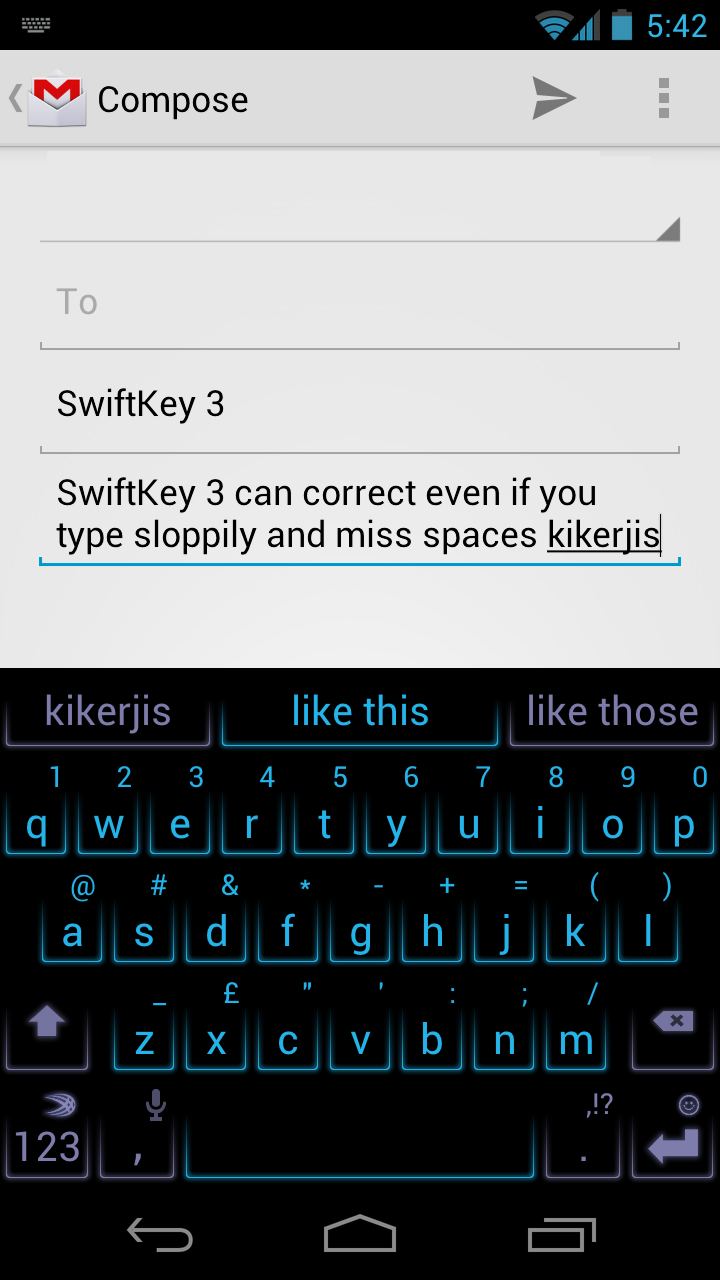
Swiftkey in action
Swiftkey has garnered praise and awards for its predictive text app. Its nifty software allows users of Android devices to speed up their typing by anticipating what they are going to type and then suggesting it for them.
I wondered how the Swiftkey database keeps up to date, to ensure that it can offer users the newest words on the block. So I asked Dr Caroline Gasperin, who leads a team of eight language processing engineers responsible for most language-related tasks at the London-based company.
She explained that Swiftkey learns an individual’s linguistic habits, and that by extension this grows its global database as a result.
“Your SwiftKey will learn any word you teach it, you only have to type it once and it will be included in your personal language model on your device,” she said.
“Through the Personalisation feature – which allows you to sync it with your Gmail, Facebook and Twitter accounts – and through continuous use, SwiftKey learns the words you use and the contexts in which you use them so that its predictions and corrections are based on your own way of writing.”
This learning can then feed into the overall word database to help the word corpus grow. Caroline said: “We’ve started putting in place the infrastructure for learning new words from our user base.
“As users use the Personalisation feature of SwiftKey, we are able to collect statistics about the words they use and identify words that we did not know before. We are putting in place a semi-automatic process to identify which of those words could become part of a standard dictionary and consequently become part of our downloadable language modules.
“This process consists of observing the frequency of use of words over time: words which used to have few occurrences across our user base, but which start becoming more frequent over time, and which are mentioned by several of our users instead of by just one or a few, are considered as good candidates for being added to our dictionaries.
“It’s worth adding we take our users’ privacy extremely seriously and have policies in place to safeguard this. We do not process a user’s data personally.”
Dr Caroline Gasperin
So has the way that new words are assimilated changed, and is the process quicker than before? Caroline said: “We look into how many different people have used an unknown word in order to consider it as a potential new word in the language instead of a personal word.
“We take our users’ privacy seriously, so we’ve developed ways to discover words in wide use instead of focusing on single users.
“We haven’t followed users’ language use for long enough to know whether new words are being adopted faster than before, but we are working on getting those statistics.”
I have long since believed that new words are being created and accepted into the language considerably quicker than before, with technology the principal driver behind that evolution. It would be interesting to revisit Swiftkey at some point soon to see whether those promised statistics back up that theory. And the company also gives us a very clear steer about how its core business has to adapt to the ever-changing delights of the English language.
Sometimes people can just get a new word wrong. It must have seemed such a good linguistic idea when Hurricane Sandy started its progression northwards up the eastern United States and prepared to amalgamate with other systems, so creating a super storm. What a great joke to dub it Frankenstorm, a monster storm for the Halloween season.
The problem is of course that it sounds funny, it automatically raises a smile as a word. But given the devastation that Frankenstorm is now predicted to wreak, it is a hollow and wholly inappropriate joke, where the name selected completely undermines the seriousness of what is expected to happen.
At the time of writing this, I don’t know whether the dire predictions for New York came true. It may be that it turned out to be a Frankenstorm in a teacup, and the name will have gone back to being a bogeyman-type appendage that gets wheeled out in the future as a way of scaring people when the wind begins to howl.
But if havoc ensued, then Frankenstorm will forever be remembered in a ghoulish way and any humour associated with the initial coining will have vanished.
Regular readers of Wordability will know just how much I love Mitt Romney. And no, that is not a political statement at all, merely an acknowledgement of how many times linguistic issues seem to have followed him around during this lengthy election campaign.
But does the campaign finally have the new word that will prove decisive? I wrote at the start of the year about how individual words have the power to win elections, with Change helping to lead Barack Obama to glory four years ago.
So far in 2012, no word has quite emerged as decisive. Mr Romney has tried, but Obamaloney was poor. Instead, he has constantly found himself at the mercy of linguistic disasters not of his own making, while phrases like 47% and Binders Full of Women have dogged him.
And now, it looks like the President has cracked it. In a speech in Virginia, Mr Obama characterised his opponent’s ability to change his mind and position on key issues as ‘Romnesia’.
And it worked. The crowd loved it. More importantly, the Twitter crowd loved it. It trended madly on the network immediately, and has quickly established itself as a hashtag to be appended to anything even vaguely anti-Republican.
It’s a great neologism. It makes you think of Romney. It makes you think of forgetting. And it encapsulates the character flaw that Mr Obama wants to draw attention to. It could do for this election what flip-flop did for George Bush against John Kerry by becoming the word which crystallises the campaign and leads to eventual victory.
Have I overstated this? It’s hard to say. In the minds of the undecided voters, one new word can stick. And finding that key new word which is never forgotten could ultimately make the difference.
It’s rare when the redefining of a word in a dictionary finds itself at the centre of a political storm. But so it is in a spectacular row in Australia.
First, the background. Australian Prime Minister Julia Gillard swept across YouTube recently following her extraordinary attack on opposition leader Tony Abbott in parliament. The attack followed the resignation of speaker Peter Slipper, who had been accused of sexual harassment. Opposition moves to unseat him saw Ms Gillard launch an attack on Mr Abbott’s own values.
Her tirade included the particularly memorable “If he wants to know what misogyny looks like in modern Australia, he doesn’t need a motion in the House of Representatives; he needs a mirror.”
There was a lot of aftermath. One strand was about semantics. Ms Gillard had used misogyny, which means a hatred of women, to mean prejudice against women. Had it been a lack of understanding of the correct meaning? Or had it been a deliberate conflation of the two senses in order to score a political point?
And then the Macquarie ditionary came along. Australia’s foremost authority on language decided to extend its definition of misogyny to a synonym for sexism, an ‘entrenched prejudice against women’, to reflect the fact that the usage of the word has changed.
Outcry? You bet. While linguists might have applauded the dictionary editors for being responsive to language change and acting accordingly, they would also have said it was a bit late, with the Oxford English Dictionary pointing out it had added the new sense 10 years ago. Meanwhile, Ms Gillard’s opponents cried foul and anger over the fact that dictionaries should not be making political points by redefining words and it was not up to the Prime Minister to misuse a word and then expect lexicographers to back her up. The Macquarie editor was forced to issue a follow-up statement further defending the decision.
There has been much debate worldwide about the word misogyny, the word sexism, their worldwide usage, whether they are the same or different, whether dictionaries should make changes in this way, and so on.
I suspect that the outcome to all of this is that even if the word misogyny had only previously meant hatred of women in people’s minds, it will now be entrenched for all with the sense of sexism as well, and that this incident has simply confirmed an evolution in meaning that has been taking place over the last 20 or 30 years. And of course, that is what language does. It is just a little uncommon for that gradual shift to become the subject of such frenzied international debate. But I think it is fair to say that misogyny is now a word with a definitive new meaning.
You know the story by now. Unheralded American sportsman is given his chance in the big time. He dominates every game he plays, becoming a national icon. His deeds spawn a new word in newpaper headlines. The word mushrooms, with official linguistic recognition not far behind. And then, the ultimate accoloade. He appears in Wordability.
OK, that’s not exactly how the story pans out. But it does seem to be a bit of a trend. Following Jeremy Lin’s basketball success earlier this year, and the associated mushrooming of Linsanity across the globe, comes another unlikely sporting and language star – Pete Kozma.
After six years on the fringes of the big time, Kozma was finally called into the St Louis Cardinals team at the end of August. Almost predictably, he has turned out to be sensational, taking a leading role in the National League series against the Washington Nationals, leading his team to victory and spawning the word Kozmania.
Will Kozmania be another Linsanity? Probably not. Jeremy Lin’s story was as much about him being the first American player of Taiwanese descent to make it in the big time as it was about an unlikely player dominating a sporting arena. And there’s something about the word – Kozmania sounds like something which grabs you for a short time and then you get over it, while Linsanity is more of a state of mind and likely to last longer.
But I could be wrong, and if I am, then who knows how many times that American sporting dream from my opening paragraph will be played out in the years to come. Especially the bit where they end up on Wordability.
There is no ignoring Boris Johnson. The Mayor of London, feted by many as a future Prime Minister, has stolen the headlines with a pair of appearances at the Tory party conference in Birmingham.
At the start of his first appearance on Monday night, he was prefaced by a video celebrating his re-election as London head honcho earlier this year. The video was preface by the caption ‘Mission Imborisable’.
A headline writer’s dream? Absolutely. An attempt to get a new word into the dictionary? Absolutely not. And yet…
As Boris coverage increases, and if stories about him and Downing Street continue to be written, the temptation to carry on using Imborisable in connection with any tale of Johnson-esque derring-do may prove irresistible to sub-editors up and down the land.
So while I do not see a future in which the OED features a word loosely defined as ‘an unlikely achievement by Boris Johnson’, I do think this is a word that will be around as a piece of political shorthand for the foreseeable future. And that is already an Imborisable achievement.
With lifespans getting longer and the structure of our lives in constant evolution, it is no surprise that changing circumstances are demanding new words.
Tweenagers is a wholly successful and well established example of this, a 21st century word to describe that awkward period between 10 and 14 when children are becoming more sophisticated but are not fully-fledged, hormonally-challenged actual teenagers.
And so at the other end of the scale comes Pretirement, a word which is slowly beginning to appear around the internet. Meanings are still being formed, but it seems to be shaking down into something which describes a new phase, namely the last period of someone’s working life in their early to mid-sixties, as they start to also focus on the things they want to do when they are fully retired.
That would be a good final meaning for pretirement, though there are currently conflicting definitions. For example, Shannon Ward and Diana Stirling believe it is a work-life balance choice that people can make much earlier in life, and have a flourishing website to prove it. Meanwhile, the Urban Dictionary reckons it is the period between higher education and work, the last chance you will have to relax for years. Interestingly, this is the meaning that has been submitted to the Collins new word suggestion project, though comments alongside the entry suggest it has been around in some form since 2005.
Nonetheless, it is clear that pretirement is a word that has not been given any kind of official recognition yet. It is being used to describe a variety of different phases, all of which are becoming a key part of modern life. I suspect it will finally become locked down as the final pre-retirement period, and it will be no surprise if it becomes as much a part of the English language as Tweenager in the next few years.

 Wordability