Why Gloomadon-Poppers will never catch on

You have to admire that Boris Johnson. He seems to be waging a one-man campaign to get a new word to take off. But after six years of trying, I think he should now concede defeat.

The Mayor of London has been at it again, describing people who believe that the city will grind to a halt during next year’s Olympics as Gloomadon-Poppers. His office has even had to explain this term, saying it is defined as people who habitually put out negative news.

The thing is, it isn’t the first time that Mr Johnson has used this term. Way back in 2005, he said that Gordon Brown was a gloomadon-popping old busybody in a piece in The Telegraph. He described Ken Loach as gloomadon-popping in a Telegraph article about the film industry in 2006. In 2008, he wrote about Gordon Brown and the gloomadon-poppers of the BBC.  And in 2009, he penned a slightly weird article about bees and the gloomadon-poppers of the Financial Times.

Yet despite all his efforts, the word will just not catch on. I have managed to find one independent usage of it, in a Daily Mail piece by Harry Phibbs from January 2011. And yet despite this linguistic cold shoulder, he is at it again and what one can only hope is a final, desperate attempt to launch his word.

I think it is obvious why this has not worked as a new word. It makes no sense when you hear it. It has to be explained to you. For a neologism to take off, you have to get it the first time you hear it. And so I am afraid, Mr Johnson, your gloomadon has been well and truly popped.

The Forth Bridge ends a Linguistic Era

While Wordability loves to celebrate the arrival of new words and phrases, it also needs to stop and mark the moment when a phrase ceases to be. Normally it would be hard to pin that down, but we can date one such occasion to December 9, 2011.

That was when the painting of the Forth Road Bridge in Edinburgh came to an end.

And so we can no longer say ‘it’s like painting the Forth Bridge’ to describe something which feels endless and which starts again as soon as it finishes. Instantly, the phrase now means ‘It will take a long time but you’ll get there in the end. Go home, you never have to do this again’. Not really much cop any more, is it.

Twitter quickly jumped into action to suggest alternatives, marking them with the hash tag #islikepaintingtheforthbridge. Politics was the most obvious subject for never-ending tasks, with suggestions such as ‘Finding a banker willing to accept responsibility for their failed gambles’ from Neocon Hitman, or Christine Roberts’ suggestion of ‘Watching David Cameron and William Hague on television’. Dan Frost went pleasingly self-referential with ‘Coming up with metaphors to replace painting the forth bridge’. But my personal favourite was Chewbacca, who went on to Twitter to suggest ‘Shaving a Wookie’. Accurate, but hard to see it catching on really.

So what should we use? It would be dull to choose something prosaic and domestic, such doing the washing or clearing up after children. After all,those are the kind of chores that the Forth Bridge phrase existed to describe. And I think that the political suggestions floating around will not be long-lasting enough to resonate in the English Language.

So what is going to exist for some time, is well known to many people and feels like it starts again as soon as it has finished. The football season? Apple product launches? Watching reality television? All accurate, but none feels solid enough.

I think we may have to wait for a new long-running project to emerge to take over the mantle. Or failing that, we can just sit it out for a few years. The paint on the Forth Bridge is bound to start peeling eventually.

A Word of the Year You Have Never Heard Of

Hot on the heels of the Oxford Dictionary announcement that ‘Squeezed Middle’ was the word of the year, the dictionary.com website has made its own announcement.

The Oxford decision to go with a word that was actually two words caused some controversy.  So the online dictionary’s decision to go with a word that nobody has ever heard of might turn out to be equally perplexing.

Their approach was to choose a word that has existed for some time but has resonance in relation to the events of the last 12 months, rather than a new word or usage from 2011.

So it is back to 1645 for this year’s word of the year – the verb Tergiversate.

It means ‘to change repeatedly one’s attitude or opinions with respect to a cause or subject’, and editors felt that it was associated with rapidly changing times and periods of tumult, thus perfectly encapsulating the ups and downs of this year.

While I understand this approach, to me this doesn’t seem in keeping with the concept of a word of the year. I am much more in favour of a new word from the previous 12 months that captures a mood or a trend, rather than simply finding a word from the past that does that same job. You wouldn’t award an Oscar to a film from the 1930s just because it said something about the state of modern society better than any contemporary movie.

I actually wish the editors had chosen another one of the words under consideration, ‘zugzwang’, a chess term in which a player is limited to moves that either cost pieces or damage their position, just because I like the sound of it. Had they done that, then maybe I would tergiversate my view of their decision.

Squeezed Middle Named Word Of The Year

Oxford Dictionaries has announced its word of the year, and it is a true reflection of British society over the last 12 months.

“Squeezed Middle”, a term coined by Labour leader Ed Miliband to describe the large portion of society most affected by Government cuts and the economic downturn, has won the accolade in both the UK and the USA, which normally selects a different word.

Some press reports have complained about the fact that the winner of word of the year is a phrase, but compound nouns have distinct meanings and therefore act like words, so that argument is a red herring. Instead, we should focus on just what this year’s winner and runners-up say about the state of the country today.

Wordability has frequently mentioned that new words and usages come from all sides, with technology a particularly rich vein, though music, sport and television also contribute their fair share of neologisms.

But squeezed middle comes straight from news reporting and shows that this year, minds have been concentrated on serious issues. This is reflected by the other words on the shortlist, which are other brand new words, new usages of existing words or words gaining particular prominence: Arab Spring, describing events in the Middle East earlier this year; Occupy, the movement to occupy prominent buildings as a protest over perceived economic injustice; Phone Hacking, the much-publicised practice of intercepting people’s phone messages; Hacktivism, gaining unauthorised access to networks for political reasons; and Sodcasting, the only non-newsworthy item on the shortlist and the act of playing music through your mobile phone in a public place.

What this list shows us is the power of the media and the way that when particular stories start to grow and gain coverage, they have to have a neat word to encapsulate their essence. Coining the right one can help to define the argument and create a perception in people’s minds about what the story is about. The internet and 24-hour news need these words and then become the perfect vehicles for disseminating this.

As well as really getting to the heart of what the economic crisis means for millions of people, I think there is another reason why squeezed middle works so well. It sounds like it always existed. When you hear the phrase, you assume it is a demographic description that has been used for eternity, rather than a phrase of the times, and this slightly timeless quality probably explains why it has stuck.

As for my word of the year? Well, since this blog has only been operating for a short time, I can suggest Doing a Tevez, Shovel-Ready and Haircut as possible candidates. But of course, there can only be one winner, and I look forward to seeing it in every dictionary next year. For me, the word of the year for 2011 is of course Wordability.

Goldlicks Planets: Why Science Needs Fairy Stories

I was recently sitting in the back of a taxi in Adelaide talking to the driver about whether life exists on other planets.

There were two things that struck me about the conversation. Firstly, I was in the back of a taxi in Adelaide discussing extra-terrestrial life. But secondly, it was the casual way that the driver referred to “Goldilocks” planets.

“Goldilocks” planets are those located in what scientists refer to as the habitable zone around a sun. Such planets can support life because their temperature is not too hot and not too cold. In fact, it is “just right”. And there was me thinking that a Goldilocks planet was one being roamed by small families of amiable bears with a healthy attitude to nutritious breakfasts.

Even though this term has been around for some years, it seems to me that it has only recently begun to be used more generally in conversation and news reporting. And yet, a couple of developments this week have led me to consider whether this term is enough, or whether we need to extend fairy tale terminology further in order to encompass the latest developments in the field of astronomy.

NASA announced this week that oceans had been discovered underneath the frozen surface of Europa, a moon of Jupiter. Europa is millions of miles away, far outside the Goldilocks zone. But what if life is present there? Scientists may then have to refer to life being possible in the “Snow Queen” zone as well.

Separately, it has also been revealed that the Goldilocks zone is larger than first thought. Scientists have suggested that the Goldilocks zone around some red dwarf stars may extend further because of the type of radiation that these stars emit, as it could melt ice and snow on planets a greater distance away than first suggested. So rather than a Goldilocks zone, we might want to start to refer to a “Snow White” zone instead. But to support this, I think we would also have to name the red dwarf star as well. “Sneezy” would be ideal, as it would suggest the projectile nature of its radiation waves.

I wonder as well whether we should extend the concept and accept that fairy tales offer us the perfect linguistic metaphor for discussing all scientific phenomena. Just imagine how much easier it would be to teach. For example, if scientists have developed a material that is robust to all manner of natural forces, following much trial and error, that could be a “Three Little Pigs” material, able to protect itself from a “Big Bad Wolf” force. If scientists are convinced they have not achieved the best result they could from an experiment and they need to wait for what is coming next, it could be termed “Billy Goats Gruff” research, with the boffin taking the role of the deluded troll. And when there is only one solution to a complex problem, scientists could be said to be searching for whatever fits the “glass slipper”.

It’s not just me who is mining this path. This week, there have been reports about the formation of the Gamburtsev mountains in Antarctica, with theories on how they came to be. It seems that they were covered with ice 34 million years ago and were then, quite literally, frozen in time. Or as it is being reported round the world, “Like Sleeping Beauty, they retained their eerie youthfulness.”

But scientists also need to be careful. Once again this week, the world has been reading about the Cern research facility in Switzerland, and the fact that for the second time, neutrinos seem to be travelling faster than the speed of light. The Cern researchers had better be right. If it turns out they are wrong after all, will anybody ever take them seriously again. Or will they come to be known as “scientists who cried wolf”.

Brad Pitt Quits Acting to Produce a New Word

The world of acting may still be coming to terms with Brad Pitt’s announcement that he will quit acting in three years’ time, but the world of lexicography may soon be welcoming a new innovater.

In making his announcement that he is going to hang up his script at the age of 50, the actor announced that instead, he is going to go behind the camera, as he has enjoyed “the producerial side”.

There seems no obvious reason why “producerial” doesn’t work as a word, even though it clearly doesn’t. Sometimes a word just sounds wrong, and that is enough reason to feel uncomfortable around it. Words ending in ‘r’ which have an ‘-ial’ tacked on the end can work. Managerial is a perfectly fine word. Or if Brad Pitt had wanted to go behind the camera in a different way, he could have had a successful directorial career.

But this is not a universal linguistic rule, it seems, and unlike some situations, where you can add a prefix or a suffix to make up a word that at least sounds OK, with this suffix, you can’t. Teacherial, actorial, hookerial – none of these add a sensible adjectival element to these professions.

It could be as simple as the fact that they are not filling a linguistic need – we don’t really need an adjective from these words, they are not filling a linguistic hole, so they simply sound wrong.

And to prove that such words are not necessary, you only have to check out the Spanish versions of the Brad Pitt story. “He disfrutado mucho el lado producerial,”, the translation declares. Producerial is not translated into a neat Spanish alternative, it seems to be producerial in any language. And so the first thing that Brad Pritt has produced since his announcement is a word that nobody needs.

What’s In a Name? Just ask Newcastle fans

There was a predictable outcry after Newcastle United announced that their St James’ Park ground is to be renamed the Sports Direct Arena. But putting aside football loyalty, why was this reaction inevitable from a linguistic point of view?

Names may not seem an obvious choice of subject for Wordability, interested as it is in new words and usages in the English Language. Proper names seem somehow outside the normal run of language, and when they are coined, it is not part of a language’s evolution. But proper nouns are fundamental to language and are words we use all the time, so when new names are used, our reaction to them is just as valid as it would be to any other kind of new word. Justification over.

I actually think about people’s names quite often. It is one of the most defining characteristics we have, and yet it is something over which we had no control. It was a decision taken about us by others, possibly before we had even been born, and people may form immediate opinions about us from our name before they have even met us. Don’t believe me? If I told you Tarquin and Persephone were coming round for dinner, you would prepare something different to what you would cook if I said that Wayne and Sharon were popping over.

Of course people do shorten their names, adopt nicknames, use middle names, add variety to the names they were given to help define their personality. But it is much harder to adapt when somebody makes an active change to their name and expects you to get used to it. I knew someone who used different names for different periods of their life, so depending on who you you spoke to about them, they used totally different names to discuss them. Other friends have decided to stop abbreviating their names, but I find it impossible to adjust. Andy, that’s you!

And this is equally true of celebrities. Former footballer Andy Cole suddenly announced he wanted to be known as Andrew Cole. Every time commentators mentioned him, I assumed they were referring to someone I had never heard of. Prince became a squiggle, and all people could do was call him the artist formerly known as Prince. Choosing an emblem has its problems, and had Prince really wanted to make a change, he should have chosen another name. Derek, perhaps.

Which brings us back to Newcastle. The reason that the change to the Sports Direct Arena is so hard for fans to take is that it is like having to use a new word, it is like being told that there has been a fundamental change in the English language, and from now on you have to refer to bread as bacon and to bacon as toast. It is impossible to do. That name is locked in your head as the right word to use for that stadium, and you can’t unlearn a word in your native tongue and replace it with something else.

It’s fine with new stadia. They are brand new concepts, if you like, so they need a new word to describe them. The fact that many of them are sponsored is irrelevant, and if they then go on to change their name again, so what, you hardly had time to get used to it in the first place. Leicester now play at the King Power Stadium. Before that, it was the Walker’s Stadium. Only fan power stopped it being called The Walker’s Bowl before that. Fans know something about what stadia should be called. Newcastle be warned.

A portrait in words heralds latest dictionary

The arrival of the new edition of the American Heritage Dictionary is no ordinary dictionary launch – it really is a new edition for the interconnected age.

But before we get to that, let’s deal with Wordability’s bread and butter. While there are 10,000 new words in this latest edition, and some great ones at that, the list tells us less about very recent language trends than the new UK volumes that Wordability recently discussed. This is because those books were annual updates. The American tome is a brand new edition which has been 11 years in the making.

Instead, what many of the new additions demonstrate is the English language’s endless creativity when it comes to the formation of new words. And this, of course, is what Wordability loves. Flexitarian, a vegetarian who occasionally lapses and eats meat or fish, is a wonderful example of English being a flexilanguage (note to American Heritage Editors – you might want to consider flexilanguage in your next edition, as in ‘English is a great flexilanguage which exhibits superb wordability’. At this rate, I could have my own dictionary.)

I am also fond of backronym, which is the formation of an acronym from a previously existing word. For example, wiki is a collaborative website, but it is also now an acronym, or more properly backronym, standing for ‘what I know is’. While I remember, I should mention I look forward to lots of snow (something new on Wordability) in the next few months.

The dictionary also has a spectacular array of scientific words, such as Spaghettification, the extreme stretching of an object by tidal forces and therefore nothing to do with the effect that pasta restaurants are having on the high street. Most magnificently of all comes uvulopalatopharyngoplasty, A surgical procedure for treating severe obstructive sleep apnea, a word that probably takes as long to say as the surgery does to perform.

But what is most interesting about this release is the marketing plan behind it. There is a large print edition, of course, but buying this now gives users access to a website and an app, so that they can look up words on the moves. The publishers still expect to sell a lot of hard copies, but they also recognise that nowadays, people simply look words up on whatever electronic device comes to hand.
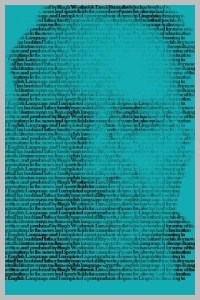
Hugh Westbrook, Wordability, in Words

Most entertaining of all is the You are Your Words website, launched to coincide with the new edition. This fun site allows you to put in a photo of yourself, together with some words which you feel sum you up (and put on the spot to come up with at least 400 characters is harder than it might appear). The site then gives you a picture of yourself drawn in words. You can even play around with the colours. This is how your Wordability author looks in blue.

We are asked to describe ourselves all the time in all sorts of settings – meeting people at parties, getting to know new colleagues, submitting CVs. We always think of these things as words on a page, not images. While the Your are Your Words image is a bit of fun, it might stop to make us think about the image of us people form when we start to speak.

Shovels at the ready

In an effort to get Britain moving again, the Coalition Government has announced a new series of building projects. And to show just how imminent they really are, the press has been describing six as ‘shovel-ready’.

From what I can see, this is the first time that this particular phrase has crossed the Atlantic. Shovel-ready, basically meaning that building can start immediately, seems to have emerged at the end of 2008 in a Barack Obama interview. So it’s a phrase you can believe in.

Now I am no building expert, but given the enormity of modern building projects, a shovel seems quite the least of it. Breeze block-ready, concrete mixer-reader, giant crane-ready – these would have carried the same meaning and also been more evocative of what was actually going to happen.

To give the Government its due, it doesn’t seem that Nick Clegg, who was promoting the policy, has actually used the phrase ‘shovel-ready’ in speeches or interviews. It’s probably a good job. If he had, some of his opponents might have wanted to know what he was shovelling.

The World’s Most Expensive Haircut

Many industries appropriate words for their own devices, but their peculiar internal language doesn’t permeate through to the masses. But there are occasions when a piece of linguistic jargon breaks free, and the current financial crisis in the Eurozone is one such example.

All over the UK, newspapers have been debating – what do you think about the haircut?

Now you could be forgiven for thinking that this is no time to be focusing on coiffures and tints, and you would be right. But of course this isn’t really about a visit to the local salon. This is about well-established financial jargon hitting the mainstream.

Understanding it is somewhat harder. The online Financial Dictionary defines a haircut as the value to securities used as collateral in a margin loan. And lots of other stuff as well. I’ll be testing you on that shortly.

I have had it explained to me a lot more simply. Basically, if I lend you £100 and then take a 50% haircut, as the European banks have, I can only expect to get £50 back. Take that, securities and collateral.

But what has actually been irritating about the coverage is the way that haircut has been liberally sprinkled throughout media reports in a kind of knowing way, without it really being defined properly. It confers a kind of legitimacy on the writers and creates the sense that they are in the know and are experts. They must be, just look at the way they effortlessly use the jargon. Many journalists would have been a lot better just avoiding the term and finding a cleaner way to express their thoughts. Hiding behind the jargon is sometimes plain lazy.

But maybe Wordability should campaign for more haircut-related financial terminology to enter common speech. Should commentators have been discussing whether the European banks should have accepted a trim, a short-back and sides or maybe a perm? Who needs to talk in percentages when you can talk in split ends instead?

Or maybe another term connected with cutting things off would have been more appropriate. But I’m not sure that headlines about the kind of circumcision the banks were going to get would really have worked.