QWERTY Overtyped By KALQ

There have been many attempts over the years to redesign the traditional keyboard. Thus far, QWERTY has reigned supreme, and so a string of letters arranged for ease of typing has become the word by which the keyboard is known.

The latest challenger to this is designed with touch screens in mind and similarly takes its name from a string of letters in the arrangement, this time the opposite corner.
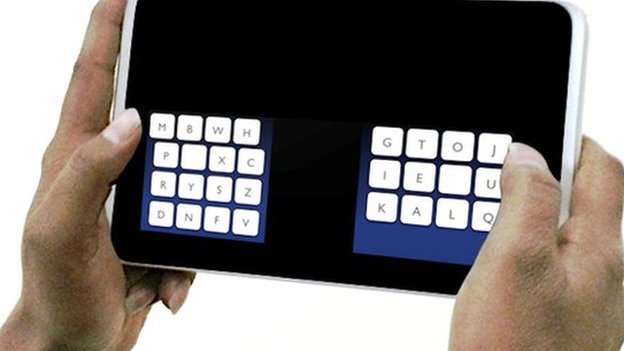
KALQ Keyboard

The KALQ keyboard is probably the only name that could have been chosen based on the arrangement, as frankly all the other lines produce unpronounceable gibberish, though I like the idea of the GTOJ keyboard challenging for typing supremacy. I wonder if the researchers made sure that there was at least one line which could be spoken to ensure their keyboard had a chance of being publicised.

Mind you, the combined brains of the University of St Andrews, the Max Planck Institute for Informatics in Germany and Montana Tech in the US aren’t entirely obsessed with simplicity. They described the old design as trapping people in “suboptimal text entry interfaces”. Well quite.

Another thing that has emerged from this story is the phrase ‘thumb typing’ which is being treated as something linguistically new by the media, a fair point since it doesn’t seem to feature in online dictionaries yet. It obviously means typing with your thumb.

As technology evolves, who knows whether this mode of typing will become the new default, and thumb typing will simply become known as typing in the future, with finger typing then being needed as the word for the old fashioned sort. And as new devices come on the market, who can say what parts of our body we might end up typing with. And that could open up a whole new chapter of neologisms.

Put An Apodment In Your Master Bedroom

A couple of interesting developments in the housing market in the United States are set to make subtle changes to the English language.

In Seattle, there have been efforts to introduce a new kind of micro-housing as a way of saving space. Apodments, as they are called, are small living spaces in a block with access to shared kitchens – the perfect solution it would seem for young people looking for a cheap way to live.

But they are not so perfect for many in the city, with protest forming against plans to develop these Apodments. With Seattle seemingly the only place where they might spring up, their rejection might see a natty new housing word stifled at birth. But never say never – if Seattle can change the world of coffee drinking, then it may yet revolutionise apartment dwelling.

Meanwhile on the other side of the country, the Washington Business Journal has reported on a well-established housing term that could be set to bite the dust. According to a survey, an increasing number of housebuilders in the area are ditching the term ‘Master Bedroom’ because they say it is sexist or has connotations of slavery. ‘Owner’s Bedroom’ is being used instead.

Ignore the fact that owner’s bedroom simply doesn’t feel like it means the same thing – master bedroom implies the main room, owner’s bedroom is ultimately any bedroom, because the owner, logically, owns all of them. I agree with others who feel that this is political correctness gone potty. Yes, there are elements in English which are inherently sexist, and yes, there are times when it is important to be aware of that and change it where necessary.

But I remember years ago working on the subject of ‘unequal lexical pairs’ and considering ‘Master’ and ‘Mistress’ as examples where the feminine form of the word has wildly different meanings to the masculine one. In particular I suggested that ‘Mistress of Arts’ implied you’d be paying for them. ‘Mistress Bedroom’ doesn’t sound much better. So there are issues with the word Master. But I don’t think they really apply with Master Bedroom. I think that it’s a phrase where the male-ness of the word Master is actually irrelevant. For me, it simply means the biggest room, the gender question has simply never struck me as a problem.

So I see no reason for the phrase Master Bedroom to disappear. Unless you are buying an Apodment, of course.

Keep Your Eyes Out For Glassholes

There seems little doubt that when Google started promoting Glass, their wearable computer, they had one eye on the effect they would have on the English language. After all, the term Glass Explorers has already been coined for the early trailblazers, and doubtless the technology giants would be hoping for further linguistic developments in the months to come.

But the problem with introducing something new is that the pesky public does have a habit of coining epithets of its own. And so it is with Google Glass, and the early perception that some of the initial users are behaving in ways that are more than slightly irritating. Being Glassholes, in fact.

It’s early days for the word, but its usage is already being noted and is spreading, and seems very likely to stick. Why is it so successful? Basically, it’s because it’s funny. I mentioned it to somebody the other day and he burst out laughing. It takes that very English type of wordplay of rhyming one word with another, a trick which is always successful, and creates a perfect play on words. It encapsulates a huge amount of meaning in a very short space.

And wouldn’t it be great if the idea of glass rhyming with its buttock-related cousin could be extended to other well-known words and phrases. You’d never think the same way about a ‘glass half full’ person. People who ‘live in glass houses’ would have a very different kind of lifestyle. Even an innocent ‘glass of milk’ would be consumed in an altogether different manner. Anyway, enough. Time to stop glassing around and publish this.

Look Through The Eyes of Glass Explorers

I once did a temping job in an office which concentrated on building and maintenance projects. I always particularly enjoyed dealings with the Electrical Foreman or the Mechanical Foreman. This was nothing to do with their personalities or the nature of the work I had to do. It was simply that I liked their job titles, and imagined them as either built of metal or plugged in as they went about their days.

Google’s new term Glass Explorers has a similar sense. Surely these are people who are tearing through jungles or across ruined buildings while taking care not to shatter. If not that, then they must be people searching for the greatest glass ever made.

Of course, neither is true. Glass Explorers are the 8,000 intrepid souls selected by Google to test their new wearable computer, which is called Glass. If Glass become a success, then the term Glass Explorers will become established as a permanent new technology word, the pioneers at the start of a new type of computing.

From a language point of view, it’s a shame that some other initiatives announced by Google have turned out to be April Fool’s japes, rather than real innovations. It’s a shame that we will not really be able to hunt for buried treasure on Google Maps by using ‘Treasure Mode’, or that ‘Google Nose’ will not become a standard way of searching for smells.

Glass Explorers however are no joke, and as technology takes another step forward, so another array of new words is set to appear.

How To Ungoogle The Dictionary

We all know that Google’s influence on our everyday lives is huge, and Wordability has written in the past about how it affects language. But rather than allowing that influence to just exist naturally, the technology giant has now taken action to directly influence a dictionary definition. The result has been that lexicography has shot into public consciousness around the world.

Google’s beef is with the Language Council of Sweden, which included the word “ogooglebar” or “ungoogleable” in its list of top words of 2012. The definition given was ‘something which cannot be found with a search engine’. However, Google objected, saying that the definition should only refer to being unable to find something when using Google, rather than any generic search engine.

Not wishing to be dictated to, or to enter into lengthy legal proceedings, the Language Council removed the word completely, while launching a robust defence of the word and criticising Google for their stance.

Sweden seems to be a hotbed of language innovation, and those who look after the language there need to be applauded for their reaction to this. Of course Google cannot dictate what should or shouldn’t be in a dictionary. Frankly they should be flattered that their company name has entered the hallowed turf trodden by Hoover or Portakabin, trade names which have crossed the divide from a single brand to become the generic term for anything in that genre. When the brand becomes the definitive word, surely it is a sign for those behind the brand that the battle is won.

Anybody using ungoogleable, or indeed Google as a verb, is using it in a generic form. Yes, most of us actually use Google itself when performing a web search, but I doubt we are thinking about that fact if we use the word, we are using it to mean search the internet. I was surprised to see that official definitions of “to Google” mention Google in them, rather than the generic act. Presumably others have been wary of the Google trademark police.

But I think the most telling thing of all is a quote given by Google to the BBC. A spokesman said: “While Google, like many businesses, takes routine steps to protect our trademark, we are pleased that users connect the Google name with great search results.” And maybe that is the point. Maybe the company is actually quite pleased when Google is used to mean generic searching, but steps in when any negative definition comes along. But the incident has not served at all to link the company with great search results in people’s minds. In fact, it simply reinforces the view that Google controls everything we do. And is now seeking to influence the meaning of words. Which, of course, it can’t.

Canberra Bashing Comes of Age

I must admit to never having heard the word Canberra Bashing. I am a little ashamed of this, given my Australian wife and reasonable lengths of time spent in the country as a result. But no matter.

Canberra Bashing has been added to the Australian National Dictionary. This publication catalogues words which are quintessentially Australian and say something about the history and culture of the country, and lexicographers feel that Canberra Bashing is a term which fits the bill.

The word has two meanings: one is the act of criticising the Australian federal government and its beaurocracy, giving it a more generic meaning of knocking authority; the other is the more parochial act of criticising the city of Canberra and its inhabitants. I have been to the Australian capital once in my life and, as I recall, l was probably guilty of Canberra bashing on my return, albeit that I didn’t know there was a handy word which to describe it.

This is clearly an Australian word, with local resonance, so it is virtually certain that it will not become a part of vocabulary in the wider English-speaking word. However, it would be nice to think that bashing could start to take on suffix duties in the manner of a -gate or a -leaks. Imagine the bashing fun we could have by appending it to all manner of places and people who provoke our ire. It’s a whole new world of word formation which I am fully in favour of.

I also think that changes in Australian English really encapsulate the straight-talking nature of its people. A word localised to Canberra which has also just achieved official recognition by the Australian National Dictionary is the one used as a term for public servants. They are referred to as Pubes. It’s a great example of an apparently simple term which says so much about what people really think.

The Baggy Green Guide To Bikers

The media coverage of the latest Oxford Dictionary online update has reversed the usual trend. Newly-added words tend to dominate the headlines. But on this occasion, it is a redefinition that has captured people’s attention.

Previously, biker has been defined as: ‘A motorcyclist, especially one who is a member  of a gang: a long-haired biker in dirty denims’. However, OED lexicographers have bowed to pressure from the biking community and removed the reference to grubbiness, with the new definition emerging as ‘A motorcyclist, especially one who is a member of a gang or group: a biker was involved in a collision with a car.’

While bikers are understood to be pleased with the decision, they may now have to deal with the fact that their mucky tendencies have been replaced in the definition by a slight on their safety record. I look forward to a future definition with the example ‘A clean-cut respectable-looking biker rode along the street and nothing of note happened at all’.

Mind you, if the OED wants to think about redefinitions, maybe it should start to ponder the meaning of the word ‘new’. After all, these quarterly updates always trumpet the new words being given status and inevitably, many of them are not that new, and I end up venting my anger about archaic words being celebrated for their novelty.

But I do feel that this quarter’s update has hit a new temporal low. As a cricket fan, I know that Baggy Green has become popularised in the last 20 years. But Australian cricketers have been donning them since time immemorial once they make the national team, so to acknowledge it now seems bizarre.

Even more bizarre is the arrival of Torch Relay and Olympic Flame. I know these really hit public consciousness during the London Olympics in 2012, but there were genuine new words associated with the torch relay such as Mother Flame, rather than terms, and indeed an event, that have been around for decades.

Or to use another apparently new word, I think this update is a bit of a mare.

Harlem Shake New Rival to Gangnam Style

A new year, a new dance, and a new challenger for the biggest craze on the Internet. The Harlem Shake is the biggest new thing on the block.

It has shot to prominence in the last couple of weeks, even though the music which has inspired it has been around since last May, which is when the song Harlem Shake was released by US DJ Baauer. It is only now, when scores of people have picked it and posted their own dances to the track on YouTube, that the concept and phrase have boomed.

So why does it work? I think it is because it ticks all the boxes for something to go viral. Fundamentally, it is easy to do and anybody can take part. A typical Harlem Shake video consists of 15 seconds of one person doing the shoulder-rolling dance, usually wearing a mask. Then everybody who was previously in shot but static is suddenly seen dancing along in equally manic fashion. And that’s basically it.

Of course the fact that it’s ludicrous helps. It is as silly as planking or Tebowing, ridiculous activities that people can partake in and share with their friends. And it has also picked up the Gangnam Style ability to get celebrities to take part, and we are already awash with football teams and other well-known groups of people doing their own Harlem Shake to get in on the act. It feels like Gangnam Style all over again.

So it is no shock that this phenomenon has taken off in the way that it has. And that means that Harlem Shake will inevitably feature in the shake-up at end of 2013 when it comes to discussing the words of the year.

The Problems Of Mixed Weight Couples

If you have never worried about how couples at opposite ends of the obesity spectrum deal with their unique relationship issues, think again. A new study has laid bare the issues faced by so-called Mixed-Weight Couples.

I can see where this phrase is coming from – its a half rhyme away from mixed-race and so seems to trip off the tongue all too easily. But is this the start of a new trend for terms which will define relationship issues by the obvious differences on show?

Will we soon be reading about mixed-height couples, how they can’ t whisper secrets to one another without getting a stiff neck or how they wrestle with other more intimate limitations caused by their height differential? And what of mixed-dextrous couples, where one is right- and one is left-handed? The problems caused by not knowing which way to hang the fridge door could break the sturdiest of marriages.

Now I’m not denying that this is a valid study touching on something new, and that some people have found some genuine support from the publication of this work. I think the term is going to find a permanent place in the lexicon. I just hope it is not the start of a barrage of similar terms.

How Twitter Has Changed Language

If there was one thing I kept on saying in 2012 it was the technology and the internet have changed forever the way that language evolves. But while I had my own instincts and observations to back that up, I was also looking around for something else to validate those claims.

So it was exciting to come across the work of Jacob Eisenstein towards the end of last year. He and his colleagues at the Georgia Institute of Technology in Atlanta have analysed a huge body of Twitter data from large cities in America and have shown how this contributes to the development of language.

The researchers found that many new words are born on Twitter, which isn’t a surprise. But what was more interesting was the way that they then grew and moved. New words often appear in cities with large African American populations before hopping to other large, urban areas. For example “bruh”, an alternative spelling of “bro” or “brother”, first arose in a few south-east cities before moving to California.

I spoke to Professor Eisenstein about the work that he and his team are undertaking, and tried to find out what it said about current language evolution and what it promised for the future.

He said: “Some of what we saw is orthographic, or a transcription of phonological differences. There are some new abbreviations, most of them not really fit for print. They tend to be quite specific geographically.”

One particular interesting aspect of Twitter language is that it is conversational English, but expressed in written form, possibly leading to a new type of communication.

Professor Eisenstein speculated: “People want to express meaning on multiple levels, maybe how you feel about it the person you are talking to. In spoken conversation you can do that without altering your vocabulary, but on Twitter you have to alter it.

“Written language was for more formal purposes but now people are using it for social interaction which might have been spoken, so written language has to be more mutli-level than it was in the past.”

He said that since first working on the subject, patterns of language movement have already started to change. For example, AF (meaning As Fuck), was characteristic of southern California, but subsequent analysis has found that it has now moved to Atlanta and is  more popular, proof of how things are changing.

In fact, the pace of change is one of the surprising things. He said: “You wouldn’t expect other types of language change to happen in two years – a generation would be a fast change, but this is very fast, happening in only a couple of years.

“I’m not sure that it’s just a Twitter thing. There is clearly a need to do things in written language that you can’t do in existing convention.”

The next step for the Professor and his team and is to analyse Twitter messages in more fine grained detail, as well as taking the work out side the US. But what is clear is that Twitter provides a unique corpus of language as it is being used, and changing today, and the work carried out on this will give us valuable insights into how English will evolve in 2013 and beyond.