The French Learn How To Kiss

The French are famously protective of their language and are constantly monitoring it to ensure that Englishisms are not creeping in. Nevertheless, the language evolves like any other, and so dictionary makers in France follow their global counterparts by regularly adding new words to their volumes.

One new addition to the Petit Robert dictionary has caused quite a stir. Because it turns out, the dictionary had no word for French Kiss. Now this has been amended, and ‘Galocher’, to kiss with tongues, has been given its own entry.

The French have been quick to defend their sexual reputation, pointing out that the novelty of the word does not mean that the practice is new. Laurence Laporte of the Robert Publishing house said: “The French have always had many expressions to describe it, such as ‘kissing at length in the mouth’, but it’s true, we’ve never had one single word.”

The term French Kiss is believed to have originated at the start of the 20th century as knowledge of amorous French practices increased. It has been amusing to see that this image of the French is being stoutly defended now, despite the obvious amusement people are finding in French Kiss only now entering the dictionary.

As Ms Laporte said,  the lack of a specific term “never stopped us doing it”.

QWERTY Overtyped By KALQ

There have been many attempts over the years to redesign the traditional keyboard. Thus far, QWERTY has reigned supreme, and so a string of letters arranged for ease of typing has become the word by which the keyboard is known.

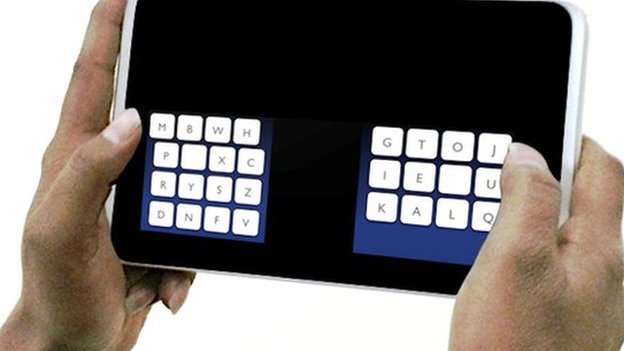
The latest challenger to this is designed with touch screens in mind and similarly takes its name from a string of letters in the arrangement, this time the opposite corner.

KALQ Keyboard

The KALQ keyboard is probably the only name that could have been chosen based on the arrangement, as frankly all the other lines produce unpronounceable gibberish, though I like the idea of the GTOJ keyboard challenging for typing supremacy. I wonder if the researchers made sure that there was at least one line which could be spoken to ensure their keyboard had a chance of being publicised.

Mind you, the combined brains of the University of St Andrews, the Max Planck Institute for Informatics in Germany and Montana Tech in the US aren’t entirely obsessed with simplicity. They described the old design as trapping people in “suboptimal text entry interfaces”. Well quite.

Another thing that has emerged from this story is the phrase ‘thumb typing’ which is being treated as something linguistically new by the media, a fair point since it doesn’t seem to feature in online dictionaries yet. It obviously means typing with your thumb.

As technology evolves, who knows whether this mode of typing will become the new default, and thumb typing will simply become known as typing in the future, with finger typing then being needed as the word for the old fashioned sort. And as new devices come on the market, who can say what parts of our body we might end up typing with. And that could open up a whole new chapter of neologisms.

How to Spend Your Bitcoin

Let’s immediately get one thing straight. If you’ve come here for an in-depth financial analysis of Bitcoins, you’re in the wrong place. But welcome anyway, have a look around. I’m sure you’ll find these offerings on financial haircuts, Greece or Fiscal Cliffs were worth the visit.

If you’re here for the more usual Wordability fare of finding out about new words, then let me tell you more. Bitcoin is not a new word per se, having first been used at the start of 2009. It emerged from research published the year before by Japanese developer Satoshi Nakamoto. But despite its history, the word is certainly novel for many of us, and its sudden emergence into the mainstream may see it being recognised as one of the words of the year.

So what is a Bitcoin? Basically, if I am understanding it correctly, it is a form of electronic currency, protected by a complex algorithm and limited to a maximum number of units. The reason you might have now heard of it is that investors are suddenly ploughing into them as the next potentially safe haven for their cash. Forget gold, it is said, Bitcoins are the new investment bling.

With prices rocketing from a few dollars to over $140, news outlets have been falling over themselves to explain them and debate them, while hackers have already been out to try and destroy them.

I clearly don’t profess to know what the future of Bitcoin is, and whether it will prove to be an investment flash in the pan or the future of money. But either way, it is now enjoying its moment in the sun, meaning that this is the year in which its place in the financial lexicon will be secured.

How To Ungoogle The Dictionary

We all know that Google’s influence on our everyday lives is huge, and Wordability has written in the past about how it affects language. But rather than allowing that influence to just exist naturally, the technology giant has now taken action to directly influence a dictionary definition. The result has been that lexicography has shot into public consciousness around the world.

Google’s beef is with the Language Council of Sweden, which included the word “ogooglebar” or “ungoogleable” in its list of top words of 2012. The definition given was ‘something which cannot be found with a search engine’. However, Google objected, saying that the definition should only refer to being unable to find something when using Google, rather than any generic search engine.

Not wishing to be dictated to, or to enter into lengthy legal proceedings, the Language Council removed the word completely, while launching a robust defence of the word and criticising Google for their stance.

Sweden seems to be a hotbed of language innovation, and those who look after the language there need to be applauded for their reaction to this. Of course Google cannot dictate what should or shouldn’t be in a dictionary. Frankly they should be flattered that their company name has entered the hallowed turf trodden by Hoover or Portakabin, trade names which have crossed the divide from a single brand to become the generic term for anything in that genre. When the brand becomes the definitive word, surely it is a sign for those behind the brand that the battle is won.

Anybody using ungoogleable, or indeed Google as a verb, is using it in a generic form. Yes, most of us actually use Google itself when performing a web search, but I doubt we are thinking about that fact if we use the word, we are using it to mean search the internet. I was surprised to see that official definitions of “to Google” mention Google in them, rather than the generic act. Presumably others have been wary of the Google trademark police.

But I think the most telling thing of all is a quote given by Google to the BBC. A spokesman said: “While Google, like many businesses, takes routine steps to protect our trademark, we are pleased that users connect the Google name with great search results.” And maybe that is the point. Maybe the company is actually quite pleased when Google is used to mean generic searching, but steps in when any negative definition comes along. But the incident has not served at all to link the company with great search results in people’s minds. In fact, it simply reinforces the view that Google controls everything we do. And is now seeking to influence the meaning of words. Which, of course, it can’t.
Canberra Bashing Comes of Age

I must admit to never having heard the word Canberra Bashing. I am a little ashamed of this, given my Australian wife and reasonable lengths of time spent in the country as a result. But no matter.

Canberra Bashing has been added to the Australian National Dictionary. This publication catalogues words which are quintessentially Australian and say something about the history and culture of the country, and lexicographers feel that Canberra Bashing is a term which fits the bill.

The word has two meanings: one is the act of criticising the Australian federal government and its beaurocracy, giving it a more generic meaning of knocking authority; the other is the more parochial act of criticising the city of Canberra and its inhabitants. I have been to the Australian capital once in my life and, as I recall, l was probably guilty of Canberra bashing on my return, albeit that I didn’t know there was a handy word which to describe it.

This is clearly an Australian word, with local resonance, so it is virtually certain that it will not become a part of vocabulary in the wider English-speaking word. However, it would be nice to think that bashing could start to take on suffix duties in the manner of a -gate or a -leaks. Imagine the bashing fun we could have by appending it to all manner of places and people who provoke our ire. It’s a whole new world of word formation which I am fully in favour of.

I also think that changes in Australian English really encapsulate the straight-talking nature of its people. A word localised to Canberra which has also just achieved official recognition by the Australian National Dictionary is the one used as a term for public servants. They are referred to as Pubes. It’s a great example of an apparently simple term which says so much about what people really think.

The Baggy Green Guide To Bikers

The media coverage of the latest Oxford Dictionary online update has reversed the usual trend. Newly-added words tend to dominate the headlines. But on this occasion, it is a redefinition that has captured people’s attention.

Previously, biker has been defined as: ‘A motorcyclist, especially one who is a member  of a gang: a long-haired biker in dirty denims’. However, OED lexicographers have bowed to pressure from the biking community and removed the reference to grubbiness, with the new definition emerging as ‘A motorcyclist, especially one who is a member of a gang or group: a biker was involved in a collision with a car.’

While bikers are understood to be pleased with the decision, they may now have to deal with the fact that their mucky tendencies have been replaced in the definition by a slight on their safety record. I look forward to a future definition with the example ‘A clean-cut respectable-looking biker rode along the street and nothing of note happened at all’.

Mind you, if the OED wants to think about redefinitions, maybe it should start to ponder the meaning of the word ‘new’. After all, these quarterly updates always trumpet the new words being given status and inevitably, many of them are not that new, and I end up venting my anger about archaic words being celebrated for their novelty.

But I do feel that this quarter’s update has hit a new temporal low. As a cricket fan, I know that Baggy Green has become popularised in the last 20 years. But Australian cricketers have been donning them since time immemorial once they make the national team, so to acknowledge it now seems bizarre.

Even more bizarre is the arrival of Torch Relay and Olympic Flame. I know these really hit public consciousness during the London Olympics in 2012, but there were genuine new words associated with the torch relay such as Mother Flame, rather than terms, and indeed an event, that have been around for decades.

Or to use another apparently new word, I think this update is a bit of a mare.

Messi Scores A Dictionary Entry

Let me get one thing straight. I love football. And, quite obviously, I also love words. So you’d think then when the two come together, it would create perfect harmony for me. But instead, I think I am witnessing a bit of a language own goal.

It is becoming trendy to celebrate the world’s greatest footballers by creating a word around their unique ability, and then sticking it in a relevant dictionary. Take the world’s greatest player, Barcelona’s Lionel Messi. The Spanish Santillana dictionary has now added to its pages the adjective ’Inmessionante’, defined as ‘ The perfect way to play football, an unlimited ability to self-improve.’

Last year, Swedish lexicographers celebrated their own footballing hero, Zlatan Ibrahomivic, with the verb Zlatanera, ‘to dominate on and off the field’.

So are we now stuck with this? Will every sporting nation start to celebrate their finest footballer with a word saying, basically, that they’re great? Will the stars’ names simply become lexically interchangeable according to which dictionary you are looking at?

You have to hope not. Or if this is simply to disappear as the publicity gimmick it seems to be, then maybe we should suggest some slightly more entertaining definitions that should be included:

“To play brilliantly before assaulting a member of the opposition team in a vital match” – To Zidane;

“To leer at the camera after scoring a vital goal in a way that suggests you have taken in more than a half-time orange” – To Maradona;

“To play quite well in a tournament before losing on penalties” – To England.

The fact is, this could run and run. Let’s hope it doesn’t.

Meggings – The Fashion Dreggings

They’re the latest thing to hit the high street. They’re leggings. For men. So they’re Meggings! Of course they are.

This piece of linguistic tomfoolery was probably the inevitable outcome once jeggings had taken a foothold in the market. The jeans/leggings combo may be a fashion success, but I fear they have opened the floodgates to what may become a new kind of lexical hybrid.

It is far from certain that anyone will ever wear Meggings, but if they do, we can only fear what might come next. Dress your dog in Deggings, combine them with a skirt and call them Skeggings, decorate them with breakfast and name them Eggings, stick them on a leotard and call them,er, Leggings. But you get my point.

Anyway, this is all a bit unnecessary. Surely they should just be displayed as leggings, albeit in menswear. After all, there are male and female equivalents of certain types of clothing and nobody has felt the need to differentiate them neologistically in the past. When women started wearing trousers, nobody thought to call them Wousers. Different kind of thing altogether, really.

Don’t Fall Over The Fiscal Cliff

There is a late entrant in the word of the year stakes. More likely, there is a front-runner for the 2013 crown. It is becoming hard to avoid the Fiscal Cliff.

The Fiscal Cliff is a term that has been coined to describe a looming financial precipice in the United States. It is a confluence of coming togethers of the end of certain tax laws and a decrease in Government spending, and commentators are worried about the effect on the US economy if legislation is not passed which could prevent all of this from happening.

Ben Bernanke, the chairman of the US Federal Reserve, is being credited with coining the phrase, having used it in evidence to the House Financial Services Commission at the end of February. He actually isn’t the first, as it appeared in analysis of George Bush’s tax cuts two years after the end of his presidency. But there is no doubt that Mr Bernanke’s usage put the term on the linguistic map.

That said, it is only in the last few weeks that it has found its way into general conversation and started appearing in earnest across the media. Given that the fiscal cliff is just around the corner, that is not really a surprise.

Maybe what is a surprise is that the term has simply been accepted and is being used by everybody, probably without really understanding it. I feel the same way about it as I did about haircut entering the vernacular last year – a term that was popular among economic commentators crossed over into the mainstream and using it seemed to confer some kind of special, inside knowledge on the users, it is almost said with a nod and a wink to those also on the inside.

For the rest of us, we hear it and then have to go and look it up and try and understand it. Shorthand phrases are good for encapsulating stories and letting everybody know what the subject is, but when they are used regularly in conversation as if everybody knows what they mean, then that can become annoying.

Thank goodness the Simpsons have been around to help explain it.

A Year Full of Bluster

I find myself at odds with dictionary.com following the announcement of its word of the year. The online dictionary has gone with Bluster as its word of 2012.

The choice is unexpected, as was Tergiversate in 2011. But it’s not that I mind the word that much, or the reasons for choosing it. I always prefer a word of the year to be something coined in that year, but dictionary.com made it clear last year that this was not a prerequisite in its selection procedure, so I will let it go.

The reasons for the selection are cogent – it has been a year of political bluster across the globe and meteorological bluster from the skies. So it is a neat word which ties together the controllable and uncontrollable elements of the last 12 months.

But what I really disagree with was the editors’ assertion that this has been a year which has been “lexicographically quiet”, to borrow their phrase. As the entries in Wordability should have demonstrated, 2012 has been anything but. Not only have there been some entertaining words coined in 2012, confirming the delicious flexibility of the language, but linguistic issues have also sparked significant debates, showing that language matters to people to a high degree. Just look back on Misogyny, Gay Marriage or Swedish Pronouns to see what I mean. It has been a year when issues of meaning and definition have hit the mainstream media.

So maybe Bluster is a good choice after all. It’s just that the bluster has extended to semantic matters as well.