Au Revoir Le Hashtag

The French have a famous aversion to the Anglicisation of their language. But such is the pervading influence of the Internet and global terms which surround it that sometimes drastic action is called for.

So it is with hashtag, that vital little addition with which all Twitter users are of course familiar. The term hashtag has started being used by the French twitterati, meaning that the arbiters of all things lexical and French have been forced to step in.

So from now on, French Twitterers are expected to refer to “mot-dièse” meaning “sharp word” whenever they wish to preface anything with an #. Like that’s going to work, and by all accounts, the move has already a received a Twitter thumbs down, especially as a musical sharp, as denoted by the new term, is not the same symbol as a hashtag.

So while France’s Commission Générale de Terminologie et de Néologie decides which popular online term to unsuccessfully target next, we are left to ponder whether this is a seminal moment for French. If the efforts of language officials do not manage to mandate what the correct word should be for the language in this case, will French continue to be a tongue which is limited and proscribed in terms of its vocabulary or will it start to take on a more English identity and be allowed to grow in a more natural way? Je ne sais pas.

Will The Dryathlon Dry Up?

I said it last year and I’ll say it again. I really wish people would stop coining new words for charity campaigns. It is already ceasing to have an impact and is detracting from the important work that is being done.

Last year, I bemoaned the Stoptober campaign, launched by the UK Government as a way of getting people to cut down on smoking. But still people carry on, and now Cancer Research has created a month where people don’t drink in order to raise money. They have called it the Dryathlon.

It is easy to see why this linguistic trick has become fashionable. Movember, the Daddy of the neologistically-inspired charity fundraiser, goes from strength to strength. Movember has undoubtedly become part of the lexicon. So people see it, see that it raises money to fight prostate cancer, and decide they want a piece of it.

But you can’t keep flogging the same idea and expect it to deliver. And the reason why Movember works, while Stoptoper and Dryathlon don’t, is that it is asking people to do something ludicrous. Growing a moustache is an inconsequential and fun thing to do. Coining a word to capture that idiocy is just part of the fun.

But giving up smoking and drinking are not fun, they are important, life-saving activities, and giving them a silly name and expecting people just to tag along, misses why Movember is a success. The word has be associated with something equally as daft for the perfect union.

I think it is a shame. I fear the idea of Dryathlon won’t really help the charity behind it, and that is a pity. You can judge for yourself how successful it has been. Dryathlon has not worked its way into popular culture the way that Movember has, awareness of it is at a much lower scale than its hirsute brother. It is simply not getting the coverage.

It’s time to find another way to raise money.

Meggings – The Fashion Dreggings

They’re the latest thing to hit the high street. They’re leggings. For men. So they’re Meggings! Of course they are.

This piece of linguistic tomfoolery was probably the inevitable outcome once jeggings had taken a foothold in the market. The jeans/leggings combo may be a fashion success, but I fear they have opened the floodgates to what may become a new kind of lexical hybrid.

It is far from certain that anyone will ever wear Meggings, but if they do, we can only fear what might come next. Dress your dog in Deggings, combine them with a skirt and call them Skeggings, decorate them with breakfast and name them Eggings, stick them on a leotard and call them,er, Leggings. But you get my point.

Anyway, this is all a bit unnecessary. Surely they should just be displayed as leggings, albeit in menswear. After all, there are male and female equivalents of certain types of clothing and nobody has felt the need to differentiate them neologistically in the past. When women started wearing trousers, nobody thought to call them Wousers. Different kind of thing altogether, really.

Do You Want Fries With Your Dictionary?

I wonder if Australia’s Macquarie dictionary is regretting the fact that it allows people to submit words for inclusion.

The Australian arm of McDonald’s is lobbying for the word Macca’s to be included in the next update. Macca’s is the abbreviation by which the chain is known by many across Australia, and the company feels that this level of lexical awareness makes it worthy of official acclamation.

A recent survey found that 55% of Australians refer to McDonald’s by the abbreviation, the only country where it is used.

McDonald’s Australia’s chief marketing officer Mark Lollback said the abbreviation “reflects our place in the Australian community. We’re the second most recognised abbreviation after footy.”

May I take this opportunity to urge Macquarie to reject this idea. Heaven only knows how many other brands will decide to target dictionary inclusion as a marketing exercise if this succeeds. And that would be a supersized irritation.

Nyasasaurus To See You

Nyasasaurus parrintoni
Nyasasaurus parrintoni. Credit: Natural History Museum, London / Mark Witton

New words emerge when new concepts or objects come along. Well, not always. A brand new word in the natural history lexicon pertains to one of the oldest things on earth.

Researchers have identified what could have been the first dinosaur to walk on earth. Its full biological name is Nyasasaurus parringtoni, though of course it is taking its place in the dinosaur pantheon as Nyasasaurus.

It has a great history, aside from being 245m years old. The fossil used to identify it was found in South Africa in 1930 and had been a mystery until researchers linked it to some samples in Cape Town.

It is called Nyasasaurus because it was found next to Lake Nyasa. It’s a shame that it was decided not to name the creature after the lake as it is called today, as Malawiasaurus has a nice ring to it.

But in years to come, when children are learning about dinosaurs and are being told about those that came at the start of the evolutionary chain, it will be interesting to look back on the moment that Nyasasaurus took its first steps towards becoming as well known as the Tyrannosaurus Rex. Even though it came chronologically first.

What is the Future for Gangnam Style?

I read an interesting piece a few weeks ago about the Gangnam Style phenomenon. It said that linguists were doubtless having a fine time working out how it had become an idiomatic expression.

The question for me is – has it become an idiomatic expression? For those of you unfamiliar with the worldwide hit (and to my shame I must admit I was ignorant of it until recently, when a South Korean friend showed the video to my wife), Gangnam Style is a Korean music and dance phenomenon which has swept the world. Dictionary definitions, such as they are, refer to it as a Korean neologism for the lifestyle of those in the upscale Gangnam district of Seoul, while the wider definition is emerging as replicating the leg wagging, horse-like dance moves of the international smash hit.

But has it become wider than that yet, in a linguistic sense? When people refer to doing things Gangnam Style, are they talking about taking on an attitude and a way of doing things, or are they just referring to people copying the dance. I think it is the latter. At the moment, the internet is awash with soldiers, prisoners and Eton pupils performing their own takes on the song. But that’s currently all it is, albeit on a vast scale.

So while Gangnam Style will undoubtedly be cited as one of the words of the year when it comes to wrapping up the language of 2012, its meaning is likely to remain fixed to musical interpretations, rather than something which has become more entrenched in society.

Pretirement – A New Phase of Life

With lifespans getting longer and the structure of our lives in constant evolution, it is no surprise that changing circumstances are demanding new words.

Tweenagers is a wholly successful and well established example of this, a 21st century word to describe that awkward period between 10 and 14 when children are becoming more sophisticated but are not fully-fledged, hormonally-challenged actual teenagers.

And so at the other end of the scale comes Pretirement, a word which is slowly beginning to appear around the internet. Meanings are still being formed, but it seems to be shaking down into something which describes a new phase, namely the last period of someone’s working life in their early to mid-sixties, as they start to also focus on the things they want to do when they are fully retired.

That would be a good final meaning for pretirement, though there are currently conflicting definitions. For example, Shannon Ward and Diana Stirling believe it is a work-life balance choice that people can make much earlier in life, and have a flourishing website to prove it. Meanwhile, the Urban Dictionary reckons it is the period between higher education and work, the last chance you will have to relax for years. Interestingly, this is the meaning that has been submitted to the Collins new word suggestion project, though comments alongside the entry suggest it has been around in some form since 2005.

Nonetheless, it is clear that pretirement is a word that has not been given any kind of official recognition yet. It is being used to describe a variety of different phases, all of which are becoming a key part of modern life. I suspect it will finally become locked down as the final pre-retirement period, and it will be no surprise if it becomes as much a part of the English language as Tweenager in the next few years.

Will Vatileaks Start A New Precedent?

I do hope that current events in the Vatican are not a sign of linguistic developments to come. I mean, Wikileaks was one thing – it took the idea of a Wiki, and the idea of Leaks, stuck them together, and came up with a title and a concept which, basically, worked.

But that doesn’t mean that -Leaks has now become an acceptable suffix which can be ramrodded onto any story about the unauthorised release of sensitive information. And yet, Vatileaks is now all over the news.

Is this the start of a new Leak inspired linguistic habit, a way of encapsulating a particular kind of scandal with a new language shorthand. I do hope not. As I wrote earlier this year, my loathing of the -Gate suffix was not helped by the Horsegate fiasco, and recent events in Downing Street, involving the Chief Whip and his bicycle, saw the arrival of Gategate, surely the nadir for -Gate and the point when, one hopes, it will finally die its natural death.

If we are ever to be freed from Gate, please do not let Leaks come into its place. We don’t want a language scandal called Leaksgate, now do we?

Whatsapp With The Dutch?

The popular smartphone messaging app WhatsApp has inspired a new word in the Dutch dictionary. Whatsappen, a verb meaning to send an electronic message, will be included in the online Van Dalen dictionary from October.

I know that WhatsApp is very popular and is constantly at the top of the iTunes charts, but I must confess to being slightly surprised at its Dutch popularity. I have never come across anybody telling me they are using it, and I have certainly never heard anybody drop it into conversation in a generic Googling type way. So I suspect this may be a development in the Dutch language that we will not be seeing replicated in English any time soon. It has also been quite fun reading the Dutch coverage using Google instant traslation, as Whatsappen translates somewhat bizarrely as ‘What Juices’.

I also wonder whether other popular apps will start to find their way into the dictionary. After all, causing rampant carnage may sound less offensive if people simply say they were ‘Angry Birdsing’.

Lesula’s Long Road to Discovery

It’s nice when a new word emerges from an unlikely source. Technology, social media, politics – they are often the lifeblood of neologisms and new usages. So it is a great pleasure to welcome the Lesula to the lexicon.

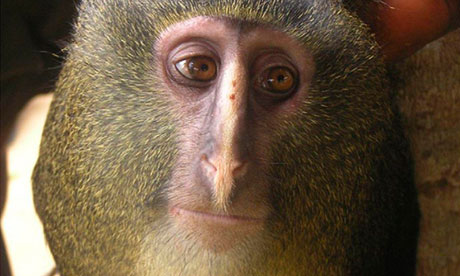
It is particularly welcome because this is a creature that has clearly been around for ages. In case you’ve missed it, the Lesula is only the second new species of monkey to be identified in Africa in the last 28 years. It was first seen in 2007 and further research has now confirmed its uniqueness.

It is known by the local Mbole people as Lesula, a word which is now globally familiar. This is a relief, as it is hard to imagine its scientific appendage, Cercopithecus lomamiensis, tripping off the tongue quite so easily.

The word itself seems destined for dictionary status and and is sure of its place in the English language of the future. I am pleased this should be guaranteed despite the fact it will probably not be widely used once this publicity blizzard has passed. I also like the fact that is is not a new word for a new concept and is instead a new word for something very, very old, but previously unknown. It is a specialised word, definitively describing something new, and I expect to see it acknowledged officially before too long.

But it is not the name for which this story will ultimately be remembered. It is the picture that has shot around the world of a plaintive looking money staring out into space. And I suspect people will remember that picture long after they have forgotten what it is called.

Lesula Monkey