A portrait in words heralds latest dictionary

The arrival of the new edition of the American Heritage Dictionary is no ordinary dictionary launch – it really is a new edition for the interconnected age.

But before we get to that, let’s deal with Wordability’s bread and butter. While there are 10,000 new words in this latest edition, and some great ones at that, the list tells us less about very recent language trends than the new UK volumes that Wordability recently discussed. This is because those books were annual updates. The American tome is a brand new edition which has been 11 years in the making.

Instead, what many of the new additions demonstrate is the English language’s endless creativity when it comes to the formation of new words. And this, of course, is what Wordability loves. Flexitarian, a vegetarian who occasionally lapses and eats meat or fish, is a wonderful example of English being a flexilanguage (note to American Heritage Editors – you might want to consider flexilanguage in your next edition, as in ‘English is a great flexilanguage which exhibits superb wordability’. At this rate, I could have my own dictionary.)

I am also fond of backronym, which is the formation of an acronym from a previously existing word. For example, wiki is a collaborative website, but it is also now an acronym, or more properly backronym, standing for ‘what I know is’. While I remember, I should mention I look forward to lots of snow (something new on Wordability) in the next few months.

The dictionary also has a spectacular array of scientific words, such as Spaghettification, the extreme stretching of an object by tidal forces and therefore nothing to do with the effect that pasta restaurants are having on the high street. Most magnificently of all comes uvulopalatopharyngoplasty, A surgical procedure for treating severe obstructive sleep apnea, a word that probably takes as long to say as the surgery does to perform.

But what is most interesting about this release is the marketing plan behind it. There is a large print edition, of course, but buying this now gives users access to a website and an app, so that they can look up words on the moves. The publishers still expect to sell a lot of hard copies, but they also recognise that nowadays, people simply look words up on whatever electronic device comes to hand.
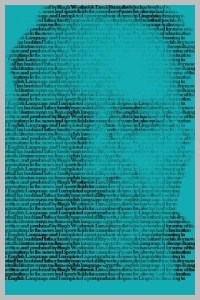
Hugh Westbrook, Wordability, in Words

Most entertaining of all is the You are Your Words website, launched to coincide with the new edition. This fun site allows you to put in a photo of yourself, together with some words which you feel sum you up (and put on the spot to come up with at least 400 characters is harder than it might appear). The site then gives you a picture of yourself drawn in words. You can even play around with the colours. This is how your Wordability author looks in blue.

We are asked to describe ourselves all the time in all sorts of settings – meeting people at parties, getting to know new colleagues, submitting CVs. We always think of these things as words on a page, not images. While the Your are Your Words image is a bit of fun, it might stop to make us think about the image of us people form when we start to speak.

A Feast of Lexicography

It’s been a fertile few weeks for lovers of new words. The Oxford English Dictionary has just issued its quarterly update, with details of its newest entries. This follows hot on the heels of new editions of two concise dictionaries, both of which achieved media coverage for their particular choice of trendy new word.

The OED has highlighed a number of the new words in its update. These include ambo, a member of an ambulance crew; kewl, an exagerrated version of cool; and Britcom, a British situation comedy.

What is interesting is how long it has taken for some words to actually be included in the OED. Wordability will always be interested in new word updates from dictionary publishers. But this blog will primarily be looking to pick up on new words and usages before they are finally legitimised by lexicographers, especially given how long this appears to take.

For example, the OED is now including stitch-up, which is of course the framing of an individual. It is, I’m sure, a word that most of us are familiar with. The OED even cites the first usage as 1980, making its 30-year wait hugely surprising. Zaatar, a middle eastern spice mix, has waited even longer and was first cited in 1917. A Zaatar stitch-up perhaps?

Also interesting are some of the words in the full list of newbies which are not highlighted by the editors. These include afterfeather, framboidal, house conventicle, picocell and take-no-shit. This week’s homework from Wordability is to find out the meaning of the above words and then put them into a coherent sentence. I expect many of you will find a suitable usage for the last word on this list in response.

Other dictionaries have recently put new words on bookshelves. Back in August, The Concise Oxford Dictionary celebrated its 100th anniversary with offerings such as mankini, jeggings, sexting and cyberbullying.

A week or so later, the new edition of Chambers Dictionary appeared, with words such as crowdsourcing, paywall and staycation, though interestingly, sexting did not pass the Chambers test, pointing to an interesting difference in criteria between rival dictionary editors.

But almost more eye-opening was the outpouring of nostalgia for words being removed from dictionaries. Oxford’s decision to discard cassette tape led to much online breast-beating as people pointed out that they were still using cassette tapes, and that despite CDs, MP3s and others, cassettes were still a valid way to listen to music.

But even more bizarre was the reaction to an announcement from Collins. Collins has not even released its new dictionary but did take the opportunity of the flurry of dictionary news to announce that some words would not be making the cut for its next edition later this year.

There seemed to be particular sadness over the loss of charabanc, a mode of horse-drawn transport which is clearly outdated but seemed to affect people disproportionately by its departure.

I don’t think this reaction was anything to do with a group of disenfranchised charabanc drivers fighting back. It seemed instead to point to a wistfulness for a golden age and an acknowledgement that former, more innocent times have long since passed.

Having said that, any declaration that a word is going out of date is clearly a challenge for hacks everywhere. Within days, the Sun, writing about Arsenal, said: “The night they lived to fight another day when, at one time, the whole out-of-control charabanc seemed to be heading for the rocks below.”

Charabanc may yet be saddling up for a reprieve.