Nerds Fight Back in Sweden

I’m finding Sweden increasingly entertaining. I’ve never actually been there, my daughter has made me sit through Mamma Mia too many times and I have recently battled through more IKEA furniture than you can shake a flat-packed bedpost at, but nonetheless, my affection for the country grows. Purely linguistically, that is.

Earlier this year, an edict suggesting the creation of the word Hen as an asexual pronoun caused an international stir. Now, language has once again proved deliciously controversial and prompted wider questions about whether English should follow suit.

The dispute is over the word ‘Nerd’ in the official dictionary of the Swedish Academy, the Svenska Akademiens Ordlista. The definition, “a simplistic and ridiculous person, dork”, or various translations of the original “enkelspårig och löjeväckande person, tönt” has caused anger among the United Nerds of Sweden (OK, I’m not sure that such an organisation exists, but wouldn’t it be great if it did).

Anyway, more than 5,000 people have now signed Nörduppropet, an online petition arguing that the definition needs to change to reflect the drive and commitment of the average nerd, and the page is swamped with positively-spun alternatives which stress the hard work, dedication and zeal of nerds around the world.

So is the definition fair, and should we be similarly bashing the doors of English dictionary makers to make them revisit their definitions? Let’s have a look. While the Oxford Dictionary has a sense of “a single-minded expert in a particular field”, its primary definition is “a foolish or contemptible person who lacks social skills or is boringly studious”. And dictionary.com is not much better, with “a stupid, irritating, ineffectual, or unattractive person”, though it does also have the computer nerd sense.

Of course we are not going to start campaigning to change this. The reason? The definitions are accurate. Nerd is a pejorative word. While it undoubtedly covers the hard work and dedication of large numbers of people, and the world would be different if it wasn’t for the work of computer nerds who have created the technology we live by today, the sense of social inadequacy is just as much a part of the meaning as all of the positive connotations. I think the petition suggests that people don’t really like admitting that about themselves. There is nothing wrong with calling yourself a nerd, but in order to do it positively, you have to be slightly tongue in cheek about it and admit that it carries negative as well as positive connotations. I will freely admit I am a word nerd, which makes me frankly irritating at times. However, I don’t see myself ever signing a petition to change the meaning of a word when it has been rendered accurately.

Sweden’s dictionary makers perhaps need to add an extra sense to their definition to cover the hard work. But if they were to completely change the meaning, it would lose its quintessential nerdiness, and indeed accuracy. And I don’t think nerds would ever really stand for something that wasn’t absolutely correct.
Whatsapp With The Dutch?

The popular smartphone messaging app WhatsApp has inspired a new word in the Dutch dictionary. Whatsappen, a verb meaning to send an electronic message, will be included in the online Van Dalen dictionary from October.

I know that WhatsApp is very popular and is constantly at the top of the iTunes charts, but I must confess to being slightly surprised at its Dutch popularity. I have never come across anybody telling me they are using it, and I have certainly never heard anybody drop it into conversation in a generic Googling type way. So I suspect this may be a development in the Dutch language that we will not be seeing replicated in English any time soon. It has also been quite fun reading the Dutch coverage using Google instant traslation, as Whatsappen translates somewhat bizarrely as ‘What Juices’.

I also wonder whether other popular apps will start to find their way into the dictionary. After all, causing rampant carnage may sound less offensive if people simply say they were ‘Angry Birdsing’.

Amazeballs to Zhoosh: Collins’ First Fruits

The dictionary revolution has truly started. Collins recently announced plans to open up the dictionary-making process to the public, and the What’s Your Word feature is now a permanent slot on the company’s website, allowing anybody to submit a word for lexicographical consideration.

Well Collins has now revealed the first words which it will include in its online dictionary. It’s a pleasingly eclectic bunch, reflecting a wide range of subjects and showcasing many words which have long since deserved their place in official reference books.

Unsurprisingly, words from technology provide fertile ground for the list. BBM and Bing carry the flag for Blackberry and Microsoft, while Twitter is well represented with three entries, Tweetup, Twitterer and Twittersphere. Bashtag, a critical hashtag, is also included. It’s also good to see more generic terms like Liveblog, Captcha and Cyberstalking making the cut.

One trend in the list is new definitions for existing words, such as Facebook as a verb, as in To Facebook someone, a usage which Wordability discussed last year. My niece will also be pleased to see that Sick, meaning good, has now been included, as it means I will no longer give her a hard stare every time I hear her say it.

Much slang and informality has been recognised for the permanent place it now has in the language. As well as the titular Amazeballs (enthusiastic approval) and Zhoosh (to make more exciting), words such as Bridezilla (an intolerable planner of her own wedding), Frenemy (a friend who behaves like an enemy) and Mummy Porn (erotic fiction for women) are bound to get attention.

There are some unusual additions. Indian cookery is a surprisingly tasty element to the list of words, with Dosa and Sambar being included, as well as Daal as an alternative spelling of Dal. Some regional dialect words are also in, such as Frape from the South West, meaning tightly bound, or Marra, a mate in Northern England. There were also some I had not heard before which simply made me laugh, such as Hangry, meaning irritable because you haven’t eaten, a state I am perpetually in, or Photobomb, which means to go into the background of somebody’s photo without realising it.

It really struck me though how useful this whole enterprise has been. I was frankly surprised to see some of the words and usages included for the first time, such as Faff as a noun, meaning something is a bit awkward to do, or Oojamaflip, a term for something when you can’t quite remember what it is. It’s a reminder that it does take a long time for terms to make it to the dictionary.

Nevertheless, Collins’ efforts to let the world at large add to the dictionary-making process is to be applauded. This first tranche of words helps its online dictionary get bang up to date. With the initiative remaining in place, it will be in pole position to add words as soon as they gain some currency and will surely help the company reflect English as it is spoken today.

New Words Which are not Ridic

The tail end of summer is always a fertile time for lovers of new words. ‘Tis the season of dictionary updates, and as each publisher puts out their own list of additions, so column inches and discussions ensue about their relative merits as English vocabulary enjoys a brief moment in the media spotlight.

Now, as Wordability prepares to enter its second year (a year already, amazing!), I have decided to buck my usual trend and not bemoan the length of time it takes for established words to gain acceptance. And it would be easy. After all, OED online has finally recognised Tweeps, a person’s Twitter followers, a word which while recent has certainly gained enough credibility over the last couple of years to have deserved official recognition before now. Meanwhile in the States, Merriam-Webster has included sexting and gastropub for the first time, words that have been around for some time.

No, what has bothered me about this particular round of coverage is the reaction of some commentators and in discussion pages about some of the words which have been included. The OED’s acceptance of Ridic and Mwahahaha, Chambers adding Glamping and Defriend to a section of its thesaurus – words such as these have seen the language pedants roll up their sleeves and go to work.

The curmudgeons argue that such words defile the English language, that its purity and beauty is somehow soiled by these trendy new terms as they gain usage and then acceptance. And of course, everybody who gives this opinion completely misses the point.

Because English is not a static museum piece, it is not a thing put into a book to be learnt as it is. No, it is a beautifully evolving stream, which is allowed to constantly change and grow to truly reflect how its speakers use it. Its incredible flexibility is one of the principal reasons behind its success as a global tongue, and not acknowledging this is simply not getting it. It is vital for dictionary makers to add new words as they become popular and embedded, and not listen to the luddites who would still speak like Shakespeare.

And people may want to view the situation in China, where natural evolution of the language is not allowed. Commonly used English words and phrases have now been included in the latest edition of the Modern Chinese Dictionary, and scholars have argued that Chinese law itself has been broken by the move.

Pedants in the English-speaking world may think they want a language which doesn’t change, and may believe they want dictionary makers to ignore the language that is actually spoken. But it is vital that lexicographers continue to reflect the language as it truly is, and that we all celebrate the fact that we live somewhere where they are allowed to do that.

Collins Makes The Dictionary Democratic

A new initative by Collins dictionaries could change the way that dictionaries are compiled forever. The company is asking members of the public to submit words to be considered for future editions.

Submission is clearly not a guarantee of success – all suggested words are put through the same rigorous assessment that a word selected by an editor would then undergo. But the amount of coverage this story has received, together with the number of words being suggested, shows just how interested people are in the evolution of English and the new words that are constantly emerging.

It is also encouraging to see some of the words being suggested, with Wordability favourites such as omnishambles and Tebowing battling with cyberstalking, amazeballs and mantyhose for attention. At this stage, nobody knows how many of these will finally be accepted. But if they are, it will prove that the acceptance process is becoming as quick as it needs to be in the age of the internet.

The level of interest has been something of a surprise to Alex Brown, the head of digital at Harper Collins. Wordability spoke to him shortly after the launch of the What’s Your Word initiative, and during the conversation, the 2,000th word was submitted. It was prairiedogged, the feeling of helplessness that overtakes you when co-workers in neighbouring cubicles constantly pop their heads up to ask you trivial, silly or frivolous questions. It was subsequently rejected by editors.

Its rejection confirms that this is still serious dictionary-making, with the submission process the only part which has been opened up. Alex told me: “This isn’t Urban Dictionary. We still have a team of editors and researchers who moderate to see if the words meet the minimum level of criteria and we are not changing that as we see it as a strength. The site opens a window on that whole process.”

He said that while they expected to receive words from technology and social media, there have been some surprises. “We have been surprised by the number of regional dialect words, and some of them are difficult to find evidence of because they are spoken not written. The global nature has also been a surprise, with quite a lot of words from India, for example, which are concepts around religion or food.”

Alex said that What’s Your Word will now be a permanent feature of the Collins process. At the moment, words which are approved still have to wait a few weeks to receive their dictionary stripes, but in time, he would like to see that process made live.

One of the advantages of this process is that words can now reach dictionaries quicker. I have often bemoaned how slow the Oxford English Dictionary is to accept new words, and while Collins will still have the final say, What’s Your Word will perform the vital process of recognising that language change itself has changed, and that the dictionary process needs to evolve along with that.

WTF! BFD is TNA

It’s not quite true to say that BFD is a TNA, but many have been saying it’s the new LOL.

BFD as an abbreviation meaning ‘Big F***cking Deal’ (language cleaned up because I know my mother reads this blog) is not new. But it has recently emerged into political discussion in America, thence onto Twitter and is now being touted by linguists as the next big things in abbreviations.

Of course, I’m not actually sure there is a next big thing in abbreviations. Linguistics isn’t showbiz, sadly. It would be nice to imagine that the abbreviation police are trawling the internet and that as soon as they come across this blog and TNA (Trendy New Abbreviation), the metaphorical trumpets will come out and it will start to adorn all short-form communication within minutes.

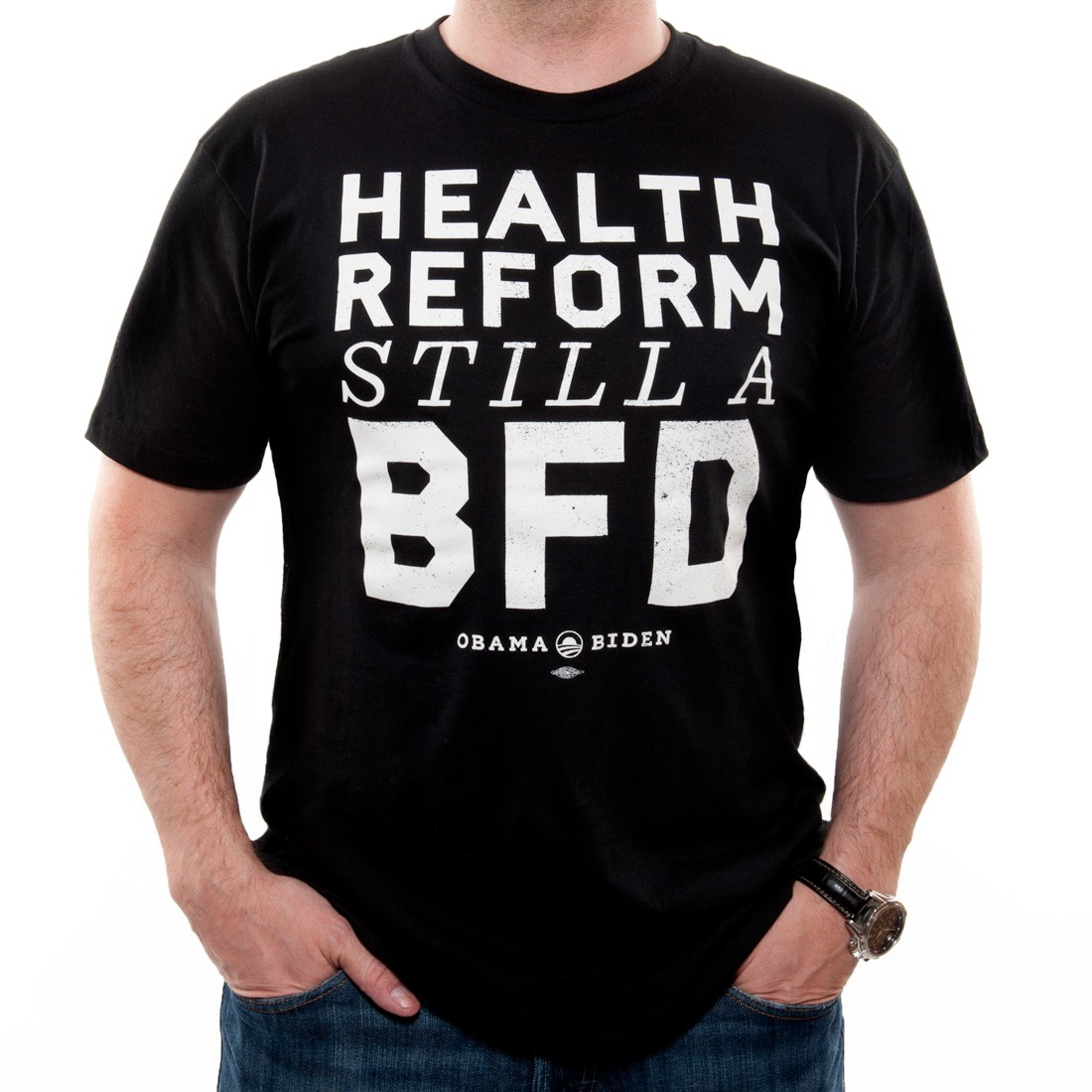
BFD T-shirtBut I digress, badly. Two years ago, US Vice President Joe Biden said that Barack Obama’s healthcare bill was not just a big deal, it was a “big f***ing deal” (hopefully my mother is still reading, you see). And with the bill recently being upheld by the Supreme Court, the Obama administration has taken to selling suitably emblazoned BFD T-shirts, (for a BFP, incidentally). The Romney campaign has criticised the behaviour as unpresidential, and the Twittersphere has gone crazy with BFD-related postings.

So the debate has been about whether BFD will become as well established as its elder statesmen, with LOL cited as as the one to beat, which begs the question of what David Cameron might believe BFD stands for. The article hyperlinked above says that the jury is still out, and quotes linguist Allan Metcalf and his scale to decide whether the word will last. The scale awards marks of 0, 1 or 2 for each of five categories:  frequency of use, unobtrusiveness, diversity of users, ability to generate related neologisms, and endurance of the concept it describes. Mr Metcalf gives BFD a paltry three points in total, suggesting it is au revoir to BFD.

I’m not so sure. I think the process of new word acceptance is beginning to change, thanks entirely to the internet. The article mentioned above says this process has not changed for a number of years, and that it takes time for a new word to bed in and get established. But with the power of global communication, and the velocity with which things become cemented on Twitter and other social media, new words and ideas now become part of the fabric of society substantially quicker. The abbreviations we now take for granted are all children of the texting age, a period that is no time at all in the entire history of human language.

It would not surprise me at all if the current popularity of BFD is a long-running thing, and it becomes just as established as all the others. And then we’ll just be saying that the debate was a BFD over nothing.

OED Feels the Bogan Backlash

The Oxford English Dictionary has never worried about justifying the length of time it takes for words to be accorded official status in one of their quarterly updates. Wordability has consistently argued that some words take a bewilderingly long time to get recognition, and in its latest update, editor John Simpson espouses the value of watching and waiting as words bed down.

This of course is all very well, but if a word has been around since the 1980s before it is finally recognised, is that not a bit too long? It is especially lengthy when that word is so well established that people then take issue with the definition.

So it is with Bogan, a word from down under which has been defined in the new OED update as a boringly conventional or old-fashioned person or an uncouth or uncultured person.

It is the “uncultured” reference that has caused controversy. Many people in Australia and New Zealand are happy to refer to themselves as bogans, on the understanding that it refers to heavy metal-listening, jeans and black T-shirt-wearing beer drinking types. They argue that they are not “uncultured”, just different cultured. Dave Snell, an offended bogan, has even completed a PhD on bogan culture.

All of this proves yet again that many of the new words touted by the OED are not new at all. If they are as old as this one, then their inclusion risks causing controversy because they are so well established that their official definition is queried.

Actually, Wordability is much more interested in a recent blog about words that Oxford experts are tracking, albeit that they are not yet officially recognised. These include squoob, a conflation of squeezed and boob and referring to a prominent cleavage protruding from a tight bodice, and phablet, which combines phone and tablet.

Will these appear in the official OED list any time soon? Undoubtedly not. But it’s word like these, if they gain any kind of regular usage, which will continue to appear on Wordability.

The Latest Word on Gay Marriage

Gay marriage is a hot political topic like never before. US President Barack Obama has backed it, individual American states are embroiled in legislation over it, while across the pond, David Cameron’s UK coalition is consulting on allowing it.

From a language point of view, the issue is fascinating. Because one of its side effects is to spawn a plethora of debate over the status of the word marriage itself.

It is important to remember just how important words are where marriage is concerned. It is one of those rare things in life where simply saying some words can effect a tangible change in somebody’s status as a person. So long as location and celebrant are approved, the act of listening to certain words and then saying “I do” moves someone from the status of being single to being married. Words enact the change.

So the use of the word marriage itself has to be important. Googling the question “Does there need to be a new word for marriage” brings up a range of debates and articles, with suggestions such as Holy Matrimony, Sanctirage or Garriage finding their way onto the internet.

But all of these miss the point. By trying to introduce new words for marriage, any sense of equality is immediately lost. If gay marriage becomes more and more accepted, calling it something else will still make it be perceived as something else, and the very way it is referred to will confer a sense that it is not equal. The current debate on Twitter, where the hashtag #gaymarriage is prevalent, makes the point. A number of people are pointing out that this hash tag gives a sense that #gaymarriage is a different type of marriage, and surely it should just be called marriage. So I think the quest for a different name is a way for people to undermine the very idea of this kind of union and strip it of its legitimacy by calling it something else.

Much more reasoned is the idea that dictionaries themselves will have to redefine marriage as a union between two people, and not a union between a man and a woman. Ben Zimmer of the Visual Thesaurus has written an excellent account of the history of the word’s definitions, and I commend it as vital background on this subject.

It is clear that this debate is going to run and run. It will only be over when the term Gay Marriage itself has been consigned to history.

Unsourcing: Free Work By Another Name

Big companies like saving money. So far, so obvious. But the growth of social media has allowed them to find a new way to provide services they used to provide before, at a fraction of the cost and quicker and better than in the past.

Basically, instead of setting up costly call centres armed with legions of people able to answer people’s questions, they simply direct people to other users, who will fight with each other to answer the questions themselves. This has become particularly prevalent in the tech and electronic sectors, where internet-linked geeks quite like to be first to help others with the relevant information.

And as every good trend deserves a word, The Economist has now given it one – welcome to the world of Unsourcing.

I must say that I find this word bizarre. Crowdsourcing, the use of large groups of people to pull together information, feels like an action to achieve a goal. Outsourcing, getting your call centre needs fulfilled by a third party, makes sense as it implies organising a service outside your organisation.

Unsourcing suggests that you stop doing something. This is of course true – you stop employing lots of people, but unemploying is already in the lexicon and is hardly the kind of word you would want to associate with a modern new way of behaving. But you don’t really un- the sourcing in this case, if I can get away with saying that, you merely redirect the source. In addition, unsourced is a perfectly legitimate word for information which is unverified. So it seems a strangely inappropriate word.

Even though it is back in the news now, the Word Spy website says it was first used in 2001 and was recognised as a trend in the IT industry back then. It says a lot for unsourcing’s sedately growth that it is only now that it seems to be back in public recognition and in with a chance as being recognised as a commonly used word.

Roll Your Eyes at Tardy Swift Boats

Heard of eye rolling, green technology and swift boats? Of course you have. They’ve been around for years. Or maybe not. I’ve said it before, and I’ll say it again – I don’t quite get the Oxford English Dictionary’s policy for their quarterly updates.

In their latest announcement, many of the words now added to the online Oxford English Dictionary seem reassuringly familiar, and not typical of new words at all. The definition for Swift Boat even cites its appearance in the 2004 US Election as the time it came into public consciousness.

Now I know that the OED policy states that words have to have been used for a certain length of time and in a sufficient variety of places for inclusion in the dictionary, and as the official arbiter of language, this is clearly the right policy. The OED is the ultimate record of language, and is clearly not going to validate some of the words which appear fleetingly and then disappear again almost without trace.

But I find the examples above bizarre, as they are all words which have been common for some time, and if I said I had been rolling my eyes over the situation, nobody would have struggled to understand me. It just strikes me that when it is being trumpeted that new words have been added to a dictionary, there should be something vaguely novel about them.

In fact, the recent financial buzz phrases, such as Robin Hood Tax and Debt Ceiling, seem to have been accepted at just the right time. It feels like they have been around for just short enough that their welcome to the OED fraternity is perfectly timed. More of the same, please.

My favourite word on the list was one I was unfamiliar with. A minimoon is a short break taken by a married couple, typically as a prelude to a longer holiday. I probably should have known it. It’s been around since the 1970s. So not so new after all.